
Which Hand Injuries Need Surgery? 10 Critical Warning Signs!
A hand injury may affect bones, joints, tendons, nerves, ligaments, blood vessels, muscles, skin, and soft tissues. Understanding which hand injuries need surgery can help patients recognise when an injury may require more than rest, medication, splinting, or physiotherapy. People in Kerala should seek prompt medical assessment when an accident causes deformity, severe swelling, numbness, loss of movement, deep wounds, or changes in finger colour.
Not every injury requires an operation. Minor sprains, stable fractures, superficial wounds, and some partial soft-tissue injuries may heal with non-surgical treatment. However, unstable fractures, divided tendons, serious nerve damage, reduced circulation, contaminated wounds, and complex crush injuries may require surgical care.
Which Hand Injuries Need Surgery?
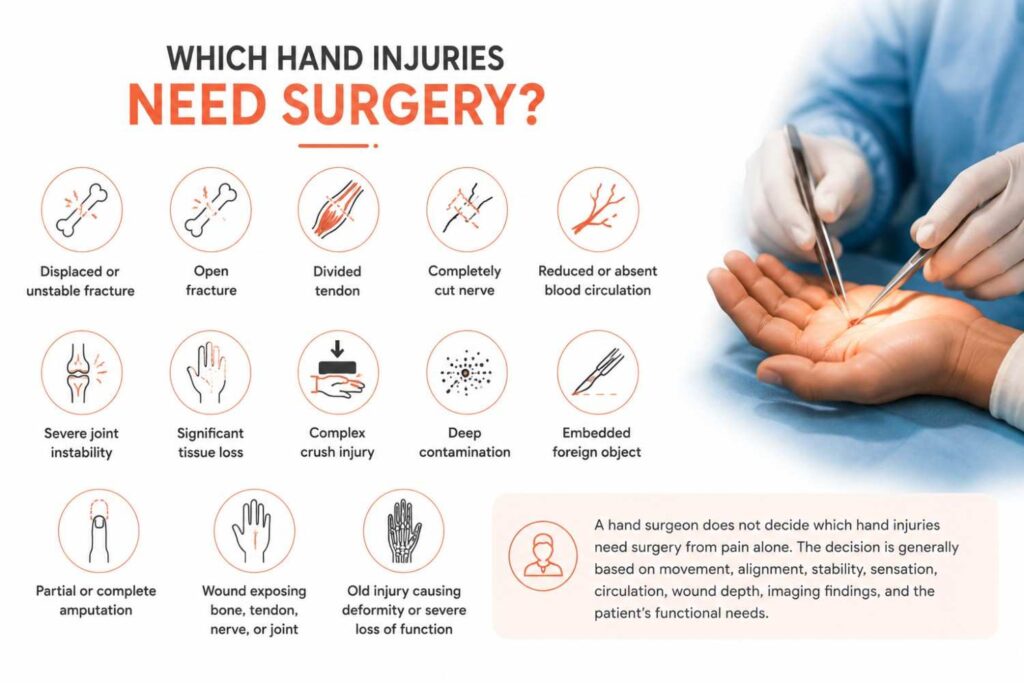
Hand injuries are more likely to require surgery when they involve:
- A displaced or unstable fracture
- An open fracture
- A divided tendon
- A completely cut nerve
- Reduced or absent blood circulation
- Severe joint instability
- Significant tissue loss
- A complex crush injury
- Deep contamination
- An embedded foreign object
- Partial or complete amputation
- A wound exposing bone, tendon, nerve, or joint
- An old injury causing deformity or severe loss of function
A hand surgeon does not decide which hand injuries need surgery from pain alone. The decision is generally based on movement, alignment, stability, sensation, circulation, wound depth, imaging findings, and the patient’s functional needs.
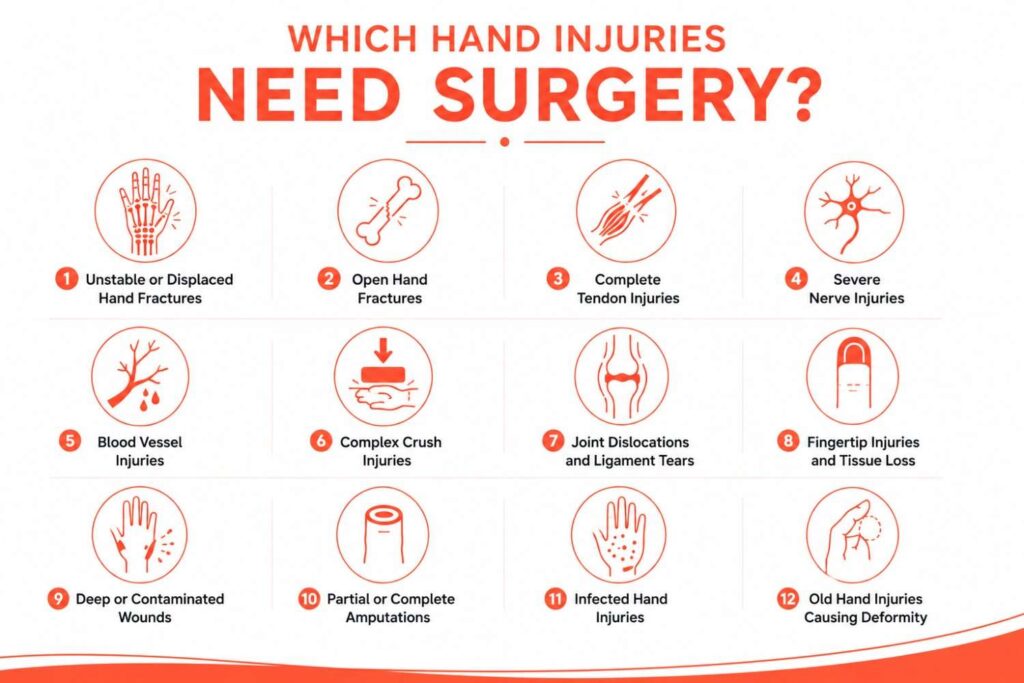
1. Unstable or Displaced Hand Fractures
A fracture occurs when a bone in the finger, thumb, hand, or wrist breaks. Some fractures remain properly aligned and stable. These may heal with a splint, cast, or buddy taping.
Surgery may be considered when the fracture is:
- Significantly displaced
- Rotated
- Angulated
- Unstable
- Broken into several pieces
- Extending into a joint
- Associated with tendon or nerve damage
- Unable to remain aligned in a cast
- Causing visible finger deformity
A rotated fracture may cause one finger to cross over another when the patient closes the hand. Even a small degree of rotation can interfere with grip and coordination.
When discussing which hand injuries need surgery, unstable fractures are among the most common examples. Surgery may use pins, screws, wires, plates, or other fixation devices to maintain alignment while the bone heals.
2. Open Hand Fractures
An open fracture occurs when a broken bone communicates with a skin wound. The bone does not always need to be visibly protruding for the fracture to be considered open.
Open fractures can expose deeper tissues to bacteria and contamination. They may also involve damage to tendons, nerves, blood vessels, muscles, and skin.
Possible treatment includes:
- Urgent wound cleaning
- Removal of contaminated or dead tissue
- Antibiotics
- Tetanus protection
- Fracture stabilisation
- Repair of damaged tendons or nerves
- Soft-tissue coverage
Open fractures are an important answer to which hand injuries need surgery because many require operative cleaning and stabilisation to reduce infection risk and support proper healing.
3. Complete Tendon Injuries
Tendons connect muscles to bones and allow the fingers and wrist to move. Flexor tendons bend the fingers, while extensor tendons help straighten them.
A tendon may be damaged by:
- Glass cuts
- Knife injuries
- Machinery accidents
- Crush injuries
- Sports trauma
- Forced bending or straightening
- Fractures
Signs of a complete tendon injury may include:
- Inability to bend a finger
- Inability to straighten a finger
- A finger resting in an unusual position
- Sudden loss of movement after a cut
- Weak or incomplete movement
- Pain along the tendon
A completely divided tendon generally cannot reconnect correctly without repair. Hand tendon repair surgery brings the damaged ends together so healing can occur.
Therefore, when patients ask which hand injuries need surgery, complete flexor or extensor tendon injuries are a major category.
Partial tendon injuries do not always require surgery, but they still need careful assessment because continued movement may worsen the tear.
4. Severe Nerve Injuries
Nerves provide sensation and control several hand muscles. A nerve can be bruised, stretched, compressed, partly cut, or completely divided.
Symptoms may include:
- Numbness
- Tingling
- Burning pain
- Electric-shock sensations
- Weakness
- Reduced coordination
- Loss of temperature awareness
- Difficulty holding small objects
A mildly bruised nerve may recover without an operation. However, a fully divided nerve often requires surgical exploration and repair because the separated ends may not reconnect properly on their own.
Surgical options may include:
- Direct nerve repair
- Nerve grafting
- Nerve transfer
- Nerve decompression
- Removal of scar tissue around the nerve
Severe nerve injuries are another clear example of which hand injuries need surgery, particularly when sensation or muscle control is completely lost.
Nerve recovery is slow. Even after successful repair, sensation and strength may take months to improve.
5. Blood Vessel Injuries
Blood vessels carry oxygen-rich blood to the hand and fingers. Deep cuts, crushing, fractures, and partial amputations can damage an artery.
Warning signs include:
- A pale finger
- Blue or dark skin
- Unusual coldness
- Severe pain
- Loss of sensation
- Weak or absent circulation
- Bleeding that does not stop
Blood vessel injuries may require urgent microsurgical repair. Delayed restoration of circulation can cause permanent tissue damage.
When identifying which hand injuries need surgery urgently, reduced blood supply is one of the most important warning signs.
A surgeon may repair the damaged vessel directly or use a vein graft to bridge a gap.
6. Complex Crush Injuries
Crush injuries can damage several hand structures at the same time. They may occur when the hand becomes trapped in machinery, a door, a vehicle, or beneath a heavy object.
A severe crush injury may affect:
- Bones
- Tendons
- Nerves
- Blood vessels
- Muscles
- Skin
- Fingernails
- Joints
Some crush injuries require more than one procedure. Initial surgery may focus on cleaning the wound, restoring circulation, stabilising fractures, and removing tissue that cannot survive.
Later procedures may repair tendons, reconstruct nerves, cover exposed structures, or improve movement.
Complex crush injuries are often included when explaining which hand injuries need surgery because non-surgical treatment cannot correct major structural damage.
7. Joint Dislocations and Ligament Tears
A dislocation occurs when the bones forming a joint move out of their normal position. Ligaments that stabilise the joint may also tear.
Many simple finger dislocations can be repositioned without surgery. Surgery may be considered when:
- The joint cannot be repositioned
- The joint remains unstable
- A ligament is completely torn
- A fracture is present
- A tendon is trapped
- Bone or soft tissue blocks reduction
- The joint repeatedly dislocates
- The injury causes major functional limitation
Persistent instability can lead to pain, weakness, abnormal movement, and early joint wear.
Therefore, severe joint and ligament damage may be included in which hand injuries need surgery, especially when splinting cannot maintain stability.
8. Fingertip Injuries and Tissue Loss
Fingertip injuries can affect the nail, skin, bone, sensation, and soft-tissue padding. They may occur due to doors, machines, knives, or workplace accidents.
Minor fingertip wounds may heal with dressings. Surgery may be considered when:
- Bone is exposed
- A large amount of tissue is missing
- The nail bed is seriously damaged
- The wound cannot close naturally
- Sensation is threatened
- A fingertip is partially amputated
- Durable soft-tissue coverage is required
Surgical treatment may include:
- Nail-bed repair
- Bone shortening
- Skin grafting
- Local tissue flaps
- Reconstructive tissue transfer
- Replantation in selected cases
Larger fingertip wounds with exposed structures may need surgery to obtain suitable coverage.
9. Deep or Contaminated Wounds
A deep wound may appear small at the skin level while extending into a tendon, joint, nerve, artery, or bone.
Surgery may be necessary when the wound:
- Contains glass, metal, soil, or grease
- Extends into a joint
- Exposes tendon or bone
- Contains dead tissue
- Has caused infection
- Involves an animal or human bite
- Cannot be cleaned safely without exploration
- Has damaged important deeper structures
Surgical wound cleaning is known as debridement. It involves removing contamination, foreign material, and damaged tissue.
Deep contaminated wounds are an important part of which hand injuries need surgery because closing such wounds without proper cleaning may trap bacteria inside.
10. Partial or Complete Amputations
A partial amputation means part of the finger or hand remains attached. A complete amputation means the separated part is no longer connected.
Treatment depends on:
- The level of injury
- The condition of the separated part
- The amount of crushing
- Time since the accident
- Blood vessel damage
- Patient health
- Expected function
- Availability of microsurgical care
Surgery may involve replantation, revision of the injured area, bone repair, tendon repair, nerve repair, blood vessel repair, or tissue coverage.
These injuries require urgent specialist assessment.
11. Infected Hand Injuries
Hand infections may develop after cuts, puncture wounds, bites, burns, or retained foreign objects.
Symptoms can include:
- Increasing redness
- Swelling
- Warmth
- Pus
- Fever
- Severe tenderness
- Pain during finger movement
- Reduced movement
- Red lines extending from the wound
Some superficial infections respond to antibiotics and wound care. Deep infections may require surgery to drain pus, clean infected tissue, remove foreign material, or protect tendons and joints.
Infections involving tendon coverings, joints, or bone may progress quickly. They may therefore be included when evaluating which hand injuries need surgery.
12. Old Hand Injuries Causing Deformity
Not all operations are performed immediately after an accident. Some patients seek treatment weeks, months, or years later because the injury healed poorly.
Old injuries may cause:
- Crooked fingers
- Rotational deformity
- Joint stiffness
- Tendon adhesions
- Weak grip
- Painful scars
- Persistent numbness
- Unstable joints
- Limited movement
Surgical options may include:
- Corrective bone surgery
- Tendon reconstruction
- Tendon release
- Nerve reconstruction
- Scar release
- Joint reconstruction
- Tissue transfer
The possibility of improvement depends on the condition of the joints, muscles, nerves, tendons, and surrounding tissues.
Emergency Warning Signs
Seek urgent medical care when a hand injury causes:
- Uncontrolled bleeding
- A pale, cold, or blue finger
- Partial or complete amputation
- Exposed bone
- Severe crushing
- Complete loss of movement
- Sudden loss of sensation
- Rapidly increasing swelling
- Deep contamination
- Signs of serious infection
These symptoms do not automatically confirm that an operation is required. However, they indicate that the patient needs immediate assessment to determine which hand injuries need surgery and which can be managed without an operation.
When Surgery May Not Be Necessary
Understanding which hand injuries need surgery also requires knowing which injuries may heal without an operation.
Non-surgical treatment may be suitable for:
- Stable fractures
- Mild sprains
- Superficial wounds
- Minor fingertip injuries
- Mild nerve bruising
- Some partial tendon injuries
- Joints that remain stable after repositioning
- Soft-tissue injuries without deep structural damage
Treatment may include:
- Rest
- Splinting
- Casting
- Buddy taping
- Medication
- Wound care
- Activity modification
- Physiotherapy
- Follow-up imaging
A patient should not decide against surgery based only on pain improvement. Fracture rotation, tendon injury, or nerve damage may remain even when swelling decreases.
Benefits of Timely Surgery
When an operation is genuinely necessary, timely treatment may help:
- Restore bone alignment
- Repair tendons
- Preserve sensation
- Restore circulation
- Improve joint stability
- Reduce infection risk
- Cover exposed structures
- Prevent deformity
- Improve grip strength
- Support daily function
Surgery cannot guarantee complete recovery. Results depend on injury severity, timing, tissue condition, general health, and rehabilitation.
Conclusion
Understanding which hand injuries need surgery helps patients recognise when a fracture, deep wound, tendon injury, nerve injury, crush accident, joint problem, or circulation change may require specialist care.
Surgery may be recommended when damaged structures cannot heal correctly through splinting, medication, wound care, or physiotherapy alone. The decision should follow a detailed examination and appropriate imaging rather than symptoms alone.
Patients from Thrissur and other parts of Kerala can visit the main Hand Injury Treatment in Thrissur pillar page to learn more about diagnosis, non-surgical management, microsurgery, rehabilitation, and recovery. Ultimately, determining which hand injuries need surgery requires individual assessment of alignment, stability, movement, sensation, circulation, contamination, and expected hand function. For additional information about breast augmentation procedures and implant safety, visit the American Society of Plastic Surgeons Breast Augmentation Resources.
FREQUENTLY ASKED QUESTIONS

Dr Vinu Roy
Plastic and Cosmetic SurgeonDr Vinu Roy is a plastic and cosmetic surgeon with expertise in cosmetic surgery, reconstructive surgery, microvascular surgery, hand surgery, trauma reconstruction, and brachial plexus procedures.
He focuses on enhancing both form and function with personalized surgical care, helping patients achieve their aesthetic and reconstructive goals with confidence.
Sushrutha Institute of Plastic, Reconstructive, and Aesthetic Surgery, Elite Mission Hospital, Koorkenchery, Thrissur

