
Tendon Injury Symptoms
Tendon injuries can affect how comfortably and effectively a joint, hand, finger, wrist, ankle, or other body part moves. Recognising tendon injury symptoms early can help people seek appropriate medical assessment before the problem interferes further with daily activities. Symptoms can vary depending on whether the tendon has been irritated, strained, partially torn, or completely ruptured.
A tendon connects muscle to bone and helps transfer muscle force to produce movement. When the tendon is damaged, its ability to perform this function may be reduced. Some injuries develop gradually through repetitive stress, while others happen suddenly because of trauma, falls, sports activities, or cuts.
What Are Tendon Injuries?
Tendons are strong connective tissues that attach muscles to bones. They help create movement by transmitting the force generated when a muscle contracts.
A tendon injury can occur when the tissue is overstretched, irritated, partially torn, or completely disrupted. The resulting symptoms depend on the location and severity of the damage.
For example, an individual with a mild tendon problem may mainly notice discomfort during particular movements. Someone with a more significant tear may experience weakness or an inability to move a joint normally.
Understanding tendon injury symptoms can therefore provide useful clues, but symptoms alone cannot determine the exact type of injury. A physical examination is often needed to establish the cause.
Common Tendon Injury Symptoms
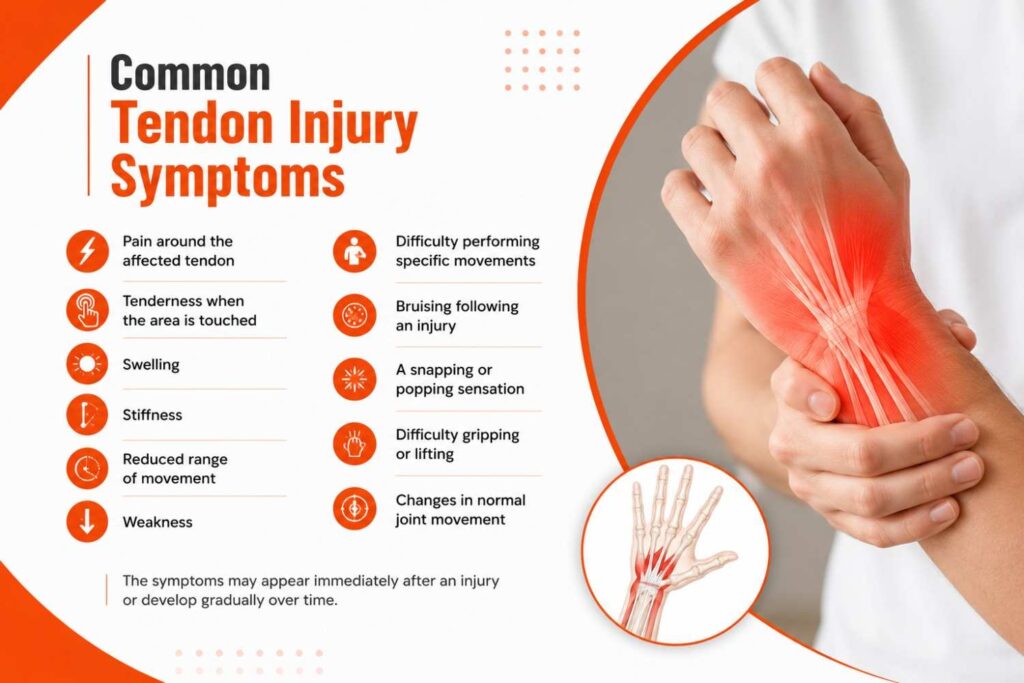
The signs of tendon damage can differ from person to person. Common tendon injury symptoms include:
- Pain around the affected tendon
- Tenderness when the area is touched
- Swelling
- Stiffness
- Reduced range of movement
- Weakness
- Difficulty performing specific movements
- Bruising following an injury
- A snapping or popping sensation
- Difficulty gripping or lifting
- Changes in normal joint movement
The symptoms may appear immediately after an injury or develop gradually over time.
Pain and Tenderness
- Pain is one of the most common tendon injury symptoms.
- The discomfort may occur directly over the affected tendon and can become more noticeable when the associated muscle is used. For example, tendon pain in the hand may become more apparent while gripping, bending, or straightening the fingers.
- Tenderness may also occur when pressure is applied to the affected area.
- However, pain intensity does not always indicate the severity of tendon damage. A significant tendon injury may sometimes present differently from what a person expects, particularly when other tissues have also been injured.
Swelling Around the Tendon
- Swelling can develop around an injured tendon, particularly after sudden trauma.
- The affected area may appear larger than usual or feel tight. Swelling can sometimes make movement uncomfortable and may occur together with tenderness or bruising.
- Persistent or increasing swelling after an injury should be assessed, especially when it is accompanied by reduced movement or weakness.
Reduced Range of Motion
- Another important sign is difficulty moving the affected joint through its normal range.
- A person may notice that a finger, wrist, ankle, or other joint does not move as freely as before. The restriction may result from pain, swelling, stiffness, or actual disruption of tendon function.
- When movement suddenly becomes restricted after trauma, medical evaluation can help determine whether a tendon, bone, ligament, nerve, or another structure is involved.
Weakness During Movement
Weakness is another important tendon injury symptom.A person may notice difficulty performing activities that previously felt easy. Examples include:
- Holding an object
- Opening a container
- Making a fist
- Lifting an item
- Pinching with the fingers
- Straightening a finger
- Pushing or pulling
- Walking or climbing stairs
The type of weakness often depends on the tendon involved.
Difficulty Bending or Straightening
- In hand injuries, difficulty bending or straightening a finger can be particularly significant.
- Flexor tendons help bend the fingers and thumb, while extensor tendons help straighten them. Damage to either group can interfere with normal hand function.
- A sudden inability to perform a movement after a cut or traumatic injury should not be assumed to be a simple strain.
Popping or Snapping Sensation
- Some tendon injuries are associated with a sudden popping or snapping sensation.
- This may occur during sports, lifting, jumping, or another forceful movement. A person may subsequently experience pain, swelling, weakness, or difficulty using the affected body part.
- A popping sensation does not automatically confirm a tendon rupture. Other tissues can also produce similar sensations. Professional assessment is therefore important when significant symptoms follow the event.
Bruising and Discolouration
- Bruising can occur when blood vessels are damaged during an injury. It may appear around the affected tendon and can be accompanied by swelling and tenderness.
- Bruising is more commonly associated with traumatic injuries, although its presence does not by itself confirm tendon damage.
- When bruising occurs together with sudden weakness or loss of movement, the injury should be evaluated.
Symptoms of a Partial Tendon Tear
A partial tendon tear means that some tendon fibres remain connected while others have been damaged.Possible tendon injury symptoms include:
- Pain during movement
- Localised tenderness
- Swelling
- Reduced strength
- Difficulty performing certain activities
- Limited movement
- Pain when the tendon is placed under load
Because some tendon continuity remains, movement may still be possible. This can sometimes make a partial tear less obvious.The absence of complete movement loss does not necessarily mean that the tendon is unaffected.
Symptoms of a Complete Tendon Rupture
A complete tendon rupture or division can cause a more pronounced loss of function.
Depending on the tendon involved, a person may experience:
- Sudden pain
- A popping sensation
- Significant weakness
- Loss of normal movement
- Inability to bend or straighten a joint normally
- Swelling or bruising
- A change in the normal position or movement of a body part
In some cases, a complete rupture requires surgical repair. The appropriate treatment depends on the tendon involved, injury location, cause, and other clinical factors.
Tendon Injury Symptoms in the Hand
The hand contains numerous tendons that allow precise and coordinated movements.
Tendon injury symptoms in the hand can include:
- Difficulty bending a finger
- Difficulty straightening a finger
- Reduced grip strength
- Pain when gripping
- Swelling around the injured area
- Tenderness
- Reduced finger movement
- Difficulty pinching
- Loss of normal hand function
A deep cut to the hand can damage tendons beneath the skin. It may also affect nerves, blood vessels, or other structures.The NHS notes that hand tendon injuries can interfere with the ability to move the hand or fingers normally and may require surgical repair in certain cases.
Acute vs Gradual Tendon Symptoms
Not all tendon injuries begin in the same way.
Acute Tendon Injuries
Acute injuries happen suddenly. They can result from:
- Falls
- Sports injuries
- Cuts
- Crush injuries
- Sudden force
- Accidents
Symptoms may appear immediately.
Gradual Tendon Problems
Gradual tendon problems can develop because of repetitive loading or continued stress.
Symptoms may initially be mild and become more noticeable during or after activity. Some people may experience stiffness after periods of rest or discomfort when performing repetitive movements.The distinction between acute and gradual symptoms can help a doctor understand the likely mechanism of injury.
When Should You See a Doctor?
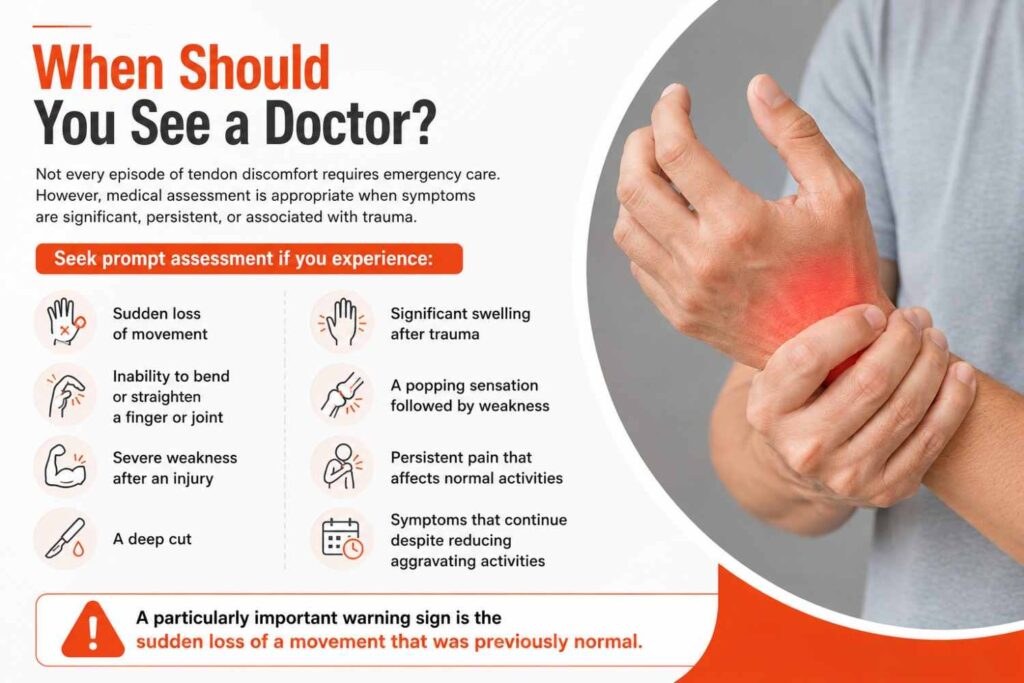
Not every episode of tendon discomfort requires emergency care. However, medical assessment is appropriate when symptoms are significant, persistent, or associated with trauma.
Seek prompt assessment if you experience:
- Sudden loss of movement
- Inability to bend or straighten a finger or joint
- Severe weakness after an injury
- A deep cut
- Significant swelling after trauma
- A popping sensation followed by weakness
- Persistent pain that affects normal activities
- Symptoms that continue despite reducing aggravating activities
A particularly important warning sign is the sudden loss of a movement that was previously normal.
What Treatment May Be Recommended?
Treatment depends on the cause and severity of the tendon problem.Possible approaches include:
- Activity Modification
Reducing activities that aggravate symptoms may be appropriate for selected tendon problems.
- Splinting
A splint may be used to protect the affected area and limit movements that place excessive stress on the tendon.
- Medication
A healthcare professional may recommend appropriate medication for pain or inflammation depending on the individual’s circumstances.
- Rehabilitation
Physiotherapy or specialist hand therapy may help restore movement, strength, and function.
- Surgical Repair
Significant tendon tears or complete tendon divisions may require surgical repair. This is particularly relevant for some traumatic hand injuries.The choice of treatment should be based on examination rather than symptoms alone.
Conclusion
Recognising tendon injury symptoms can help you respond appropriately when pain, weakness, swelling, or movement changes occur. Symptoms may range from mild discomfort during activity to a sudden inability to bend or straighten a joint after trauma.
A deep cut, sudden loss of movement, significant weakness, or a suspected tendon rupture deserves timely medical assessment. The earlier the injury is properly identified, the sooner an appropriate management plan can be considered. For additional information about breast augmentation procedures and implant safety, visit the American Society of Plastic Surgeons Breast Augmentation Resources.
FREQUENTLY ASKED QUESTIONS

Dr Vinu Roy
Plastic and Cosmetic SurgeonDr Vinu Roy is a plastic and cosmetic surgeon with expertise in cosmetic surgery, reconstructive surgery, microvascular surgery, hand surgery, trauma reconstruction, and brachial plexus procedures.
He focuses on enhancing both form and function with personalized surgical care, helping patients achieve their aesthetic and reconstructive goals with confidence.
Sushrutha Institute of Plastic, Reconstructive, and Aesthetic Surgery, Elite Mission Hospital, Koorkenchery, Thrissur

