
7 Powerful Symptoms of Hand Nerve Injury You Should Know Now
The symptoms of hand nerve injury can sometimes be subtle at first, but they may significantly affect sensation, movement, grip, and coordination. If you have recently experienced a cut, crush injury, fall, accident, or other hand trauma, recognizing the symptoms of hand nerve injury early can help you seek appropriate medical assessment. In Thrissur, patients with hand trauma may need hand injury treatment specialist evaluation when numbness, tingling, weakness, or loss of sensation continues after an injury.
The hand contains several important nerves that carry signals between the brain, spinal cord, and fingers. These nerves help you feel touch, temperature, pressure, and pain while also controlling specific muscles involved in hand and finger movement.
A nerve may be stretched, compressed, bruised, partially damaged, or completely cut. The resulting symptoms of hand nerve injury depend on which nerve is affected and how severe the damage is.
What Are the Symptoms of Hand Nerve Injury?
The symptoms of hand nerve injury occur when a nerve cannot properly transmit sensory or motor signals. A person may experience one symptom or several symptoms at the same time.
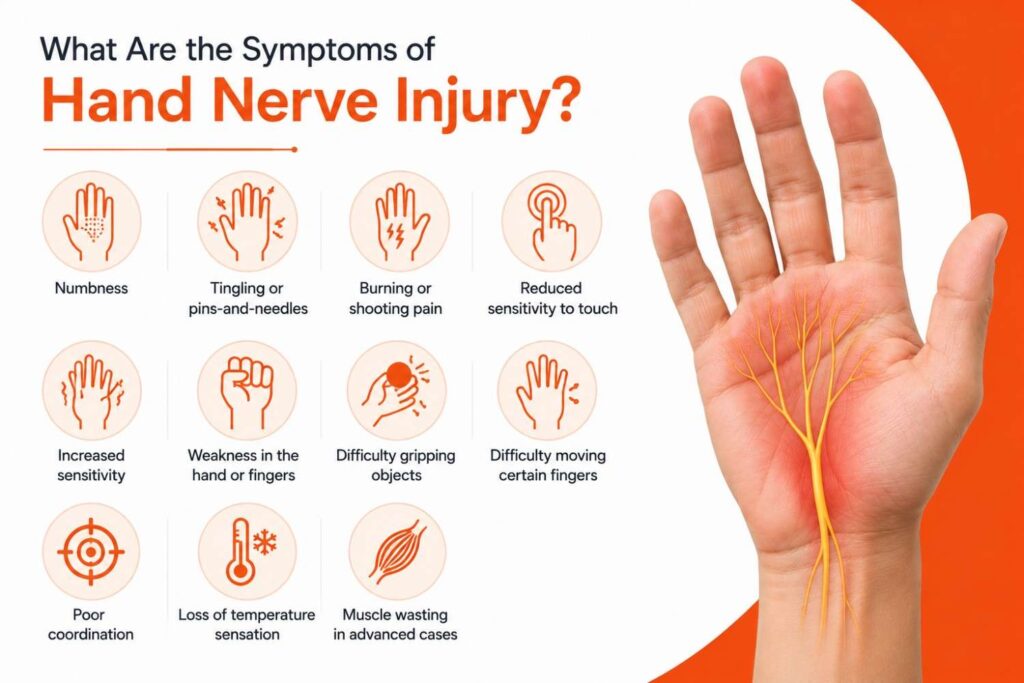
Common symptoms of hand nerve injury include:
- Numbness
- Tingling or pins-and-needles sensations
- Burning or shooting pain
- Reduced sensitivity to touch
- Increased sensitivity
- Weakness in the hand or fingers
- Difficulty gripping objects
- Difficulty moving certain fingers
- Poor coordination
- Loss of temperature sensation
- Muscle wasting in more advanced cases
The exact symptoms of hand nerve injury depend on whether the damaged nerve primarily provides sensation, controls movement, or performs both functions.
According to Mayo Clinic, peripheral nerve injuries can cause numbness, tingling, pain, weakness, muscle cramps, and difficulty performing everyday activities. Early assessment is important when neurological symptoms appear.
7 Important Symptoms of Hand Nerve Injury
1. Numbness or Loss of Feeling
One of the most recognizable symptoms of hand nerve injury is numbness.
You may notice that part of the hand or one or more fingers feels less sensitive than usual. Touch may feel dull, distant, or completely absent.
After a deep cut or traumatic injury, persistent numbness may suggest that a sensory nerve has been damaged.
Loss of sensation is particularly important because the affected area may not properly detect heat, cold, pressure, or pain. This can increase the risk of accidentally injuring the hand without realizing it.
2. Tingling and Pins-and-Needles Sensation
Tingling is another common symptom. People often describe it as:
- Pins and needles
- Prickling
- Crawling sensation
- Electric-like feeling
- Mild buzzing
Tingling may occur continuously or come and go.
The symptoms of hand nerve injury can change during the healing process. However, persistent or worsening tingling following trauma should not simply be ignored.
3. Burning or Shooting Pain
Nerve-related pain can feel different from ordinary muscle or wound pain.
Some patients describe the sensation as burning, sharp, shooting, stabbing, or electric.
Pain may travel along the pathway of the affected nerve. In some cases, even light contact with the skin can feel unusually painful.
This type of discomfort can be among the more noticeable symptoms of hand nerve injury, particularly when sensory nerve fibres are irritated or damaged.
4. Weakness in the Hand or Fingers
Nerves do more than carry sensation. Motor nerves also send signals to muscles that produce movement.
When a motor nerve is injured, the hand or specific fingers may become weak.
You may notice difficulty:
- Holding a cup
- Turning a key
- Opening a jar
- Using tools
- Pinching small objects
- Writing
- Buttoning clothing
- Performing precise movements
Weakness is one of the symptoms of hand nerve injury that deserves medical assessment, especially when it develops after a traumatic event.
5. Difficulty Moving Specific Fingers
A nerve injury can interfere with the muscles responsible for particular finger movements.
For example, you may find it difficult to bend, straighten, spread, or bring certain fingers together.
This can sometimes be confused with a tendon injury. That is why a specialist examination is important. A deep hand injury can damage nerves, tendons, blood vessels, or more than one structure at the same time.
6. Reduced Coordination and Grip Control
Another possible symptom is reduced coordination.
The hand may feel clumsy, and movements that were previously automatic can become difficult.
You might drop objects more frequently or struggle with tasks requiring fine motor control.
Reduced coordination can occur because sensory information from the hand is impaired or because motor nerve function has been affected.
7. Changes in Protective Sensation
Protective sensation helps you recognize potentially harmful stimuli such as excessive heat, sharp pressure, or injury.
When nerve function is impaired, you may not recognize an injury immediately.
For example, a person with reduced sensation may touch a hot surface without immediately withdrawing the hand.
This makes sensory loss one of the important symptoms of hand nerve injury to take seriously.
Types of Nerve Injuries in the Hand
Understanding the type of nerve injury can help explain why the symptoms of hand nerve injury vary between patients.
- Nerve Compression
Pressure on a nerve can interfere with its normal function.
Symptoms may include tingling, numbness, pain, and weakness.
- Nerve Stretching
A sudden injury may stretch a nerve without completely cutting it.
Some stretched nerves can recover gradually, depending on the extent of damage.
- Nerve Contusion
A direct blow can bruise a nerve and temporarily interfere with its function.
- Partial Nerve Injury
A nerve may be damaged without being completely divided. Recovery depends on the severity and location of the injury.
- Complete Nerve Division
A completely severed nerve is a more serious injury. Surgical repair may be considered depending on the injury and clinical findings.
Treatment decisions depend on the extent and cause of nerve damage. Nerves that remain intact have a greater potential for spontaneous recovery than completely divided nerves.
Symptoms of Hand Nerve Injury vs Tendon Injury
It can be difficult to determine whether an injury has affected a nerve or tendon based only on symptoms.
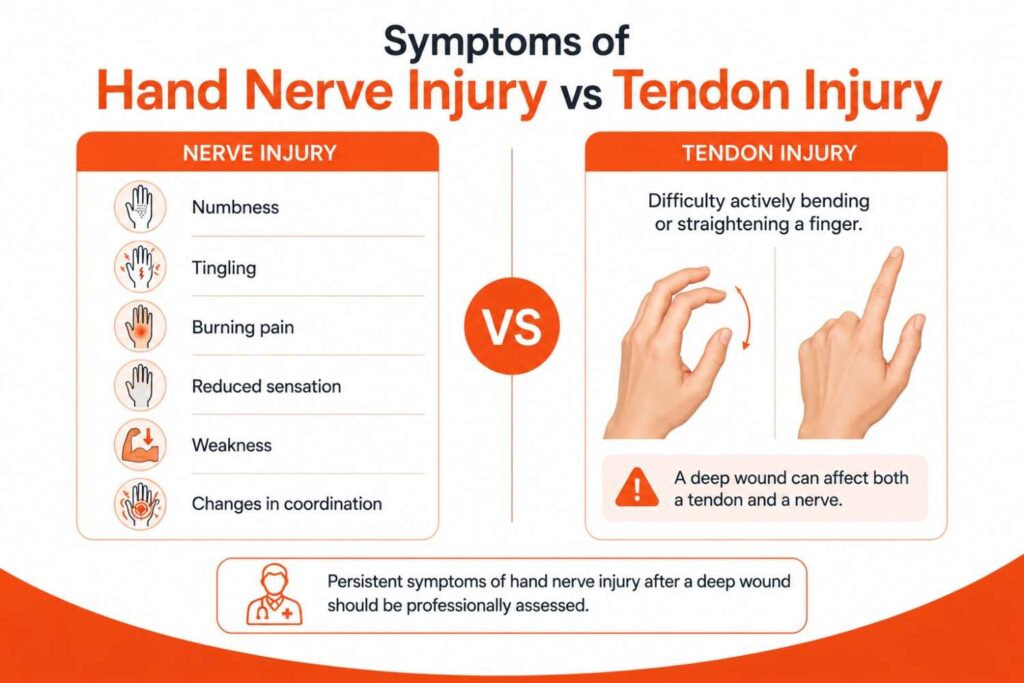
Nerve injuries commonly produce:
- Numbness
- Tingling
- Burning pain
- Reduced sensation
- Weakness
- Changes in coordination
Tendon injuries are more commonly associated with difficulty actively bending or straightening a finger.
However, a traumatic wound can damage both a tendon and a nerve.
For this reason, persistent symptoms of hand nerve injury after a deep wound should be professionally assessed rather than diagnosed at home.
When Should You See a Doctor?
You should seek medical evaluation if you develop symptoms of hand nerve injury after trauma, particularly when symptoms persist or worsen.
Medical assessment is especially important if you experience:
- Complete loss of sensation
- Significant numbness
- New weakness
- Inability to move a finger
- Severe burning or shooting pain
- Persistent tingling
- Loss of grip strength
- A deep cut
- A crush injury
- Increasing symptoms after an accident
Mayo Clinic advises medical evaluation when weakness, tingling, numbness, or complete loss of feeling occurs because early diagnosis and treatment can help reduce the risk of lasting nerve problems.
Benefits of Early Evaluation
Recognizing the symptoms of hand nerve injury early has practical benefits.
- Identifying the Damaged Structure
Early examination can help distinguish nerve damage from tendon, bone, ligament, or blood vessel injuries.
- Protecting Hand Function
Prompt management may help protect movement, strength, and sensation.
- Planning Appropriate Treatment
Some injuries require observation, while others may need surgery. Proper assessment helps determine the appropriate approach.
- Supporting Rehabilitation
Early diagnosis can also help establish a suitable rehabilitation plan.
Can Symptoms of Hand Nerve Injury Improve?
Yes, improvement is possible in many nerve injuries, but the outcome varies.
Factors that can influence recovery include:
- Type of nerve injury
- Location of the injury
- Severity of damage
- Whether the nerve is completely divided
- Time between injury and treatment
- Overall health
- Rehabilitation
- Presence of scar tissue or other injuries
A nerve that has been compressed or mildly injured may recover differently from a completely severed nerve.
Therefore, the presence of symptoms of hand nerve injury does not automatically mean that permanent loss of function will occur. The prognosis must be assessed individually.
Conclusion
Recognizing the symptoms of hand nerve injury is an important part of responding appropriately after hand trauma. Numbness, tingling, burning pain, weakness, reduced grip, difficulty moving fingers, and changes in protective sensation can indicate that a nerve is not functioning normally.
The symptoms of hand nerve injury can overlap with signs of tendon, bone, joint, or soft-tissue damage, so professional assessment is important when symptoms continue after an accident or wound. Diagnosis may involve physical examination, sensory testing, nerve conduction studies, EMG, ultrasound, or MRI depending on the situation.
Treatment can range from observation and rehabilitation to nerve repair, nerve grafting, or nerve transfer for selected serious injuries. Early evaluation, appropriate treatment, and structured rehabilitation can help support the best possible functional recovery. For additional information about breast augmentation procedures and implant safety, visit the American Society of Plastic Surgeons Breast Augmentation Resources.
FREQUENTLY ASKED QUESTIONS

Dr Vinu Roy
Plastic and Cosmetic SurgeonDr Vinu Roy is a plastic and cosmetic surgeon with expertise in cosmetic surgery, reconstructive surgery, microvascular surgery, hand surgery, trauma reconstruction, and brachial plexus procedures.
He focuses on enhancing both form and function with personalized surgical care, helping patients achieve their aesthetic and reconstructive goals with confidence.
Sushrutha Institute of Plastic, Reconstructive, and Aesthetic Surgery, Elite Mission Hospital, Koorkenchery, Thrissur

