
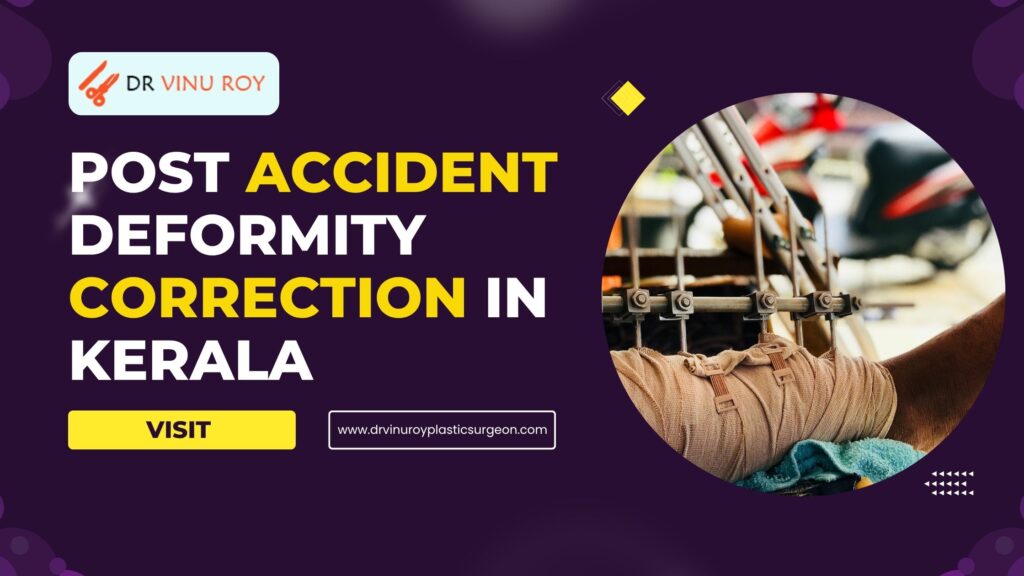
Life can change in an instant when a major accident occurs. Whether from a road traffic collision, industrial injury, fall, or other traumatic event, the physical, emotional and functional impact of trauma can be profound. When bone fractures heal poorly, soft tissues scar, or joints lose alignment, the result may be permanent deformity—visible changes in appearance, impaired mobility, discomfort, and reduced quality of life.
At Dr Vinu Roy Plastic Surgeon’s clinic in Kerala, we specialise in post-accident deformity correction—offering advanced surgical and non-surgical solutions to restore both form and function. Our holistic approach combines trauma reconstruction, plastic/reconstructive surgical expertise and patient-centred care.
Understanding Post-Accident Deformity
After serious trauma, the body’s healing mechanisms may not always restore normal anatomy. Some common problems include:
Fractures that heal in malalignment (e.g., angulated or rotated bones) leading to deformity and joint dysfunction.
Soft-tissue injuries (muscle, tendon, skin) that heal with scar contracture, limiting movement or distorting contours.
Joint dislocations or injuries leading to arthritis, misalignment and visible asymmetry.
Limb length discrepancies—one leg shorter or longer than the other due to unequal healing.
Facial injuries or skull fractures leading to altered appearance, asymmetry of the face, and functional issues (jaw, bite, vision).
Combined injuries (bones + soft-tissue + nerves) where complex reconstruction is required for optimal outcome.
In Kerala, given the high traffic density, industrial sectors, and mixed rural-urban terrain, trauma is unfortunately common. As a result, the need for specialised deformity correction clinics has grown.
Why Choose Kerala—and Why Choose an Expert Like Dr Vinu Roy
Kerala has built a strong reputation for high-quality healthcare that blends skilled professionals, advanced infrastructure and patient-focused services. When it comes to deformity correction, choosing a specialist clinic brings added value. At Dr Vinu Roy Plastic Surgeon’s centre in Kerala:
We provide comprehensive assessment: evaluating bone alignment, joint function, soft-tissue condition, nerve/vascular involvement and cosmetic aspects.
State-of-the-art facilities: modern imaging, 3D planning, intra-operative navigation, microsurgical techniques and specialised rehabilitation.
Multidisciplinary teamwork: we collaborate closely with orthopaedic trauma surgeons, physiotherapists, occupational therapists and prosthetic/orthotic specialists.
Personalized care: your treatment plan is tailored to your specific injury profile, functional goals and lifestyle.
Aftercare and rehabilitation: key to successful reconstruction is not just surgery but the rehabilitation that follows—working with dedicated therapists and support services.
Types of Post-Accident Deformity Correction Procedures
Bone Realignment and Osteotomy
When a bone has healed in poor alignment—angulated, rotated or shortened—surgical bone cutting (osteotomy) may be required to restore normal shape and length. This is commonly done in long bones such as the femur, tibia, humerus, or in smaller bones of the arms and hands. Plates, screws, rods or external fixation devices may be used.
Limb Lengthening or Shortening
If one limb is significantly longer or shorter than the other due to trauma, procedures can equalise the length. Lengthening uses external fixators or internal devices (motorised nails) that slowly stretch bone and soft tissue over time. Shortening involves removing bone or adjusting alignment.
Joint Reconstruction
Trauma to joints often leads to early arthritis, misalignment, stiffening or deformity (for example in the knee, shoulder, elbow or ankle). Joint reconstruction may include corrective osteotomy, cartilage repair, ligament reconstruction, or even joint replacement targeted at younger patients.
Soft-Tissue Scar Release and Reconstruction
When injuries cause extensive scarring, contractures (tight, thick scar tissue) or skin defects, reconstructive plastic surgery becomes necessary. Techniques include scar excision, flap coverage, skin grafts, tissue expanders, microsurgery for nerve or vessel repair, and dedicating therapy to regain movement and appearance.
Facial and Maxillofacial Deformity Correction
Facial trauma may leave lasting asymmetry—jaw deformities, malocclusion (bite problems), zygomatic fracturing (cheekbones), orbital injuries (around eyes). At a specialist clinic a reconstructive and aesthetic plan is essential to restore both function (chewing, vision) and pleasing appearance.
Combined Trauma Reconstruction
Many patients present with complex injuries—bones, joints, nerves, vessels, soft tissues all involved. A comprehensive reconstructive plan addresses all elements. For example: a leg injury might need bone realignment, scar release, nerve repair and reconstructive flap coverage.
Benefits of Post-Accident Deformity Correction
Undergoing deformity correction offers multiple advantages:
Improved function: restoration of proper alignment, joint mobility and limb length promotes better movement and reduces pain.
Aesthetic symmetry: normalising shape, correcting visible deformity, improving body image and mental wellbeing.
Pain relief: Malaligned bones and mis-healed joints often lead to early arthritis and chronic pain; correcting these issues prevents or delays those outcomes.
Preventing further complications: Unequal limb lengths or joint deformities increase risk of further injury, early degeneration and secondary problems.
Enhanced quality of life: When function and appearance are improved, patients often return to activities, work and recreation with more confidence.
The Treatment Journey: What to Expect
Your path to recovery involves several phases. At Dr Vinu Roy Plastic Surgeon’s centre in Kerala:
Consultation and Assessment
You’ll meet with the surgeon, review your injury history, prior treatments, imaging and any functional limitations. We examine bone alignment, joint function, soft-tissue condition, nerve or vascular damage and aesthetic concerns.
Planning and Imaging
High-resolution imaging (X-rays, CT scans, MRIs) plus 3D modeling may be used. A personalized reconstruction plan is developed—choosing methods, timing and goals.
Surgery or Intervention
Depending on the complexity, the surgery may involve bone realignment, lengthening, scar release, flap reconstruction or a combination. Surgical time and hospital stay depend on the extent of reconstruction.
Rehabilitation
Following the procedure, dedicated physical therapy, occupational therapy (for hand/arm injuries) and orthotics or prosthetics may be required. Rehabilitation is as critical as the surgery itself for optimal recovery.
Follow-up and Monitoring
Regular follow-ups ensure healing is proceeding as expected, bone consolidation is seen, soft tissue is recovering, and alignment is maintained. Adjustments may be needed depending on progress.
Who Is a Good Candidate for Deformity Correction?
Ideal candidates include those who have already undergone initial trauma treatment but are left with malalignment, limb-length difference, joint deformity, scar contractures or functional deficits. Patients must be medically stable, have realistic expectations and understand that reconstruction is a process—not an instant fix. Age, general health, bone quality, smoking status and commitment to rehabilitation all affect the outcome. At Dr Vinu Roy’s centre we evaluate each case individually to determine suitability and timing.
Risks and Considerations
As with any complex reconstructive work, risks exist: infection, non-union or delayed bone healing, nerve or vessel injury, residual asymmetry, graft or flap failure, and need for revision surgeries. Proper patient selection, surgeon experience, diligent follow-up and rehabilitation reduce risk significantly.
Why Correcting Deformity in Kerala Matters
Correcting post-accident deformity is more than a cosmetic exercise—it preserves long-term health, function and quality of life. In Kerala’s context, where trauma is prevalent, accessible high-quality reconstructive services allow patients to receive world-class care locally rather than travelling far. With experts like Dr Vinu Roy Plastic Surgeon, patients have access to state-of-the-art techniques, personalized care and a support system tailored to their recovery.
The outcome is not just about looking normal—it’s about moving normally, working fully and living with confidence again.
| Type of Deformity | Cause (Post-Accident) | Common Symptoms/Problems | Recommended Surgical/Non-Surgical Procedures | Expected Outcome |
|---|---|---|---|---|
| Bone Malalignment (Angulation/Rotation) | Improper healing of fractures, delayed treatment, external fixation issues | Bent limb, abnormal rotation, pain, difficulty walking/using limb | Corrective osteotomy, internal fixation with plates/rods, external fixators | Restores alignment, improves mobility, reduces long-term arthritis risk |
| Limb Length Discrepancy | Bone loss, growth-plate injury, malunion after trauma | Limping, back pain, gait imbalance, difficulty with sports/work | Limb lengthening (external fixators or internal nails), bone shortening procedures | Restores equal limb length, improves gait and posture |
| Joint Deformity or Stiffness | Joint fractures, ligament injuries, cartilage damage, mismanaged dislocations | Limited movement, early arthritis, pain, visible deformity | Joint reconstruction, osteotomy, arthroplasty (joint replacement), ligament repair | Better joint motion, pain relief, improved daily functioning |
| Soft-Tissue Contractures and Scarring | Deep cuts, burns, crush injuries, delayed wound healing | Tight skin, restricted movement, cosmetic deformity, discomfort | Scar release, Z-plasty, skin grafts, local or free flaps, tissue expanders | Improved mobility, smoother appearance, reduction of tightness |
| Facial Asymmetry or Skull Deformity | Facial fractures, orbital injuries, jaw trauma, soft-tissue loss | Cheek/jaw misalignment, bite problems, eye position issues, aesthetic imbalance | Maxillofacial reconstruction, bone grafts, implants, contouring, microsurgery | Restored facial balance, improved function (bite, vision), enhanced aesthetics |
| Nerve or Vascular Damage | Deep lacerations, crush injuries, fractures affecting nerves/vessels | Numbness, weakness, loss of function, coldness, tissue damage | Nerve repair/grafting, vascular repair, microsurgical reconstruction | Recovery of sensation/function, prevention of further tissue loss |
| Combined Complex Trauma | Multiple injuries involving bone + muscle + skin + nerves | Severe deformity, functional loss, chronic pain, cosmetic concerns | Multi-stage reconstruction, bone realignment, soft-tissue flaps, nerve repair, rehab | Comprehensive improvement in form, mobility, and quality of life |
How long does the recovery process take?
Recovery time depends on the procedure complexity. Simple scar release may take a few weeks; major bone reconstruction and lengthening may take several months to over a year.
Will I require multiple surgeries?
In many cases, yes. Complex deformities often require staged procedures and combined interventions (bone + soft-tissue + joint work).
Is it only about aesthetics?
No. While appearance matters, the primary goals are function, pain reduction and longevity of joints and limbs.
Can I return to work or sports?
Yes—in most cases. The goal is to restore maximal function. With proper rehab, many patients resume work, sports and daily life.
Can deformity correction be done many years after the accident?
Yes. Even if the accident occurred many years ago, deformity correction is still possible. Many patients come for treatment long after the initial injury, especially when pain, functional limitations or cosmetic concerns worsen. Advanced imaging, osteotomy techniques, and reconstructive procedures allow surgeons to correct old malunions, joint deformities and scar contractures effectively.
Conclusion
Post-accident deformity correction in Kerala offers a pathway to reclaiming normalcy after traumatic injuries. Whether it’s a healed fractured bone that never aligned, a scar contracture limiting motion, a limb-length discrepancy affecting gait, or a facial injury altering appearance—the right reconstructive plan makes a profound difference. At the clinic of Dr Vinu Roy Plastic Surgeon, every patient receives individualized care, advanced surgical options, and a rehabilitation-driven approach that combines expertise with empathy.
If you or a loved one are living with a deformity from past trauma—don’t accept life with reduced function or appearance. Seek expert assessment, understand your options, and explore how reconstruction can give you back not just a better look—but a better life.

