
Causes of Tendon Injuries
Tendon injuries can develop suddenly after an accident or gradually because of repeated stress. Understanding the causes of tendon injuries can help explain why pain, weakness, stiffness, or reduced movement may occur in different parts of the body. Tendons are strong tissues that connect muscles to bones, but repeated loading, sudden force, age-related changes, and certain risk factors can make them more vulnerable to injury.
Some tendon problems are linked to overuse, while others occur when a tendon is suddenly stretched beyond its normal capacity. A fall, sports injury, deep cut, or forceful movement may result in a partial tear or complete tendon rupture. Mayo Clinic also identifies repetitive movement, sudden injury, ageing, improper technique, and insufficient recovery as important factors associated with tendon problems.
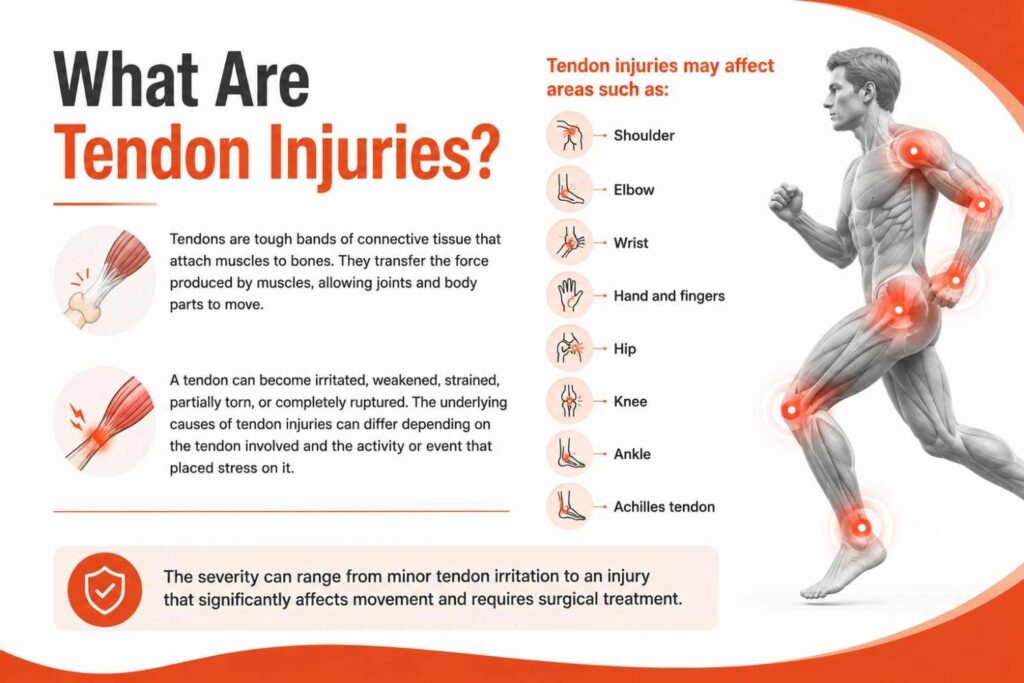
What Are Tendon Injuries?
Tendons are tough bands of connective tissue that attach muscles to bones. They transfer the force produced by muscles, allowing joints and body parts to move.A tendon can become irritated, weakened, strained, partially torn, or completely ruptured. The underlying causes of tendon injuries can differ depending on the tendon involved and the activity or event that placed stress on it.
Tendon injuries may affect areas such as:
- Shoulder
- Elbow
- Wrist
- Hand and fingers
- Hip
- Knee
- Ankle
- Achilles tendon
The severity can range from minor tendon irritation to an injury that significantly affects movement and requires surgical treatment.
Main Causes of Tendon Injuries
1. Overuse and Repetitive Movement
- One of the most common causes of tendon injuries is repeated stress.
- When the same movement is performed again and again, the tendon may experience repeated loading. If adequate recovery is not allowed, the tissue may become irritated or develop small areas of damage.
Examples include:
- Repeated lifting
- Frequent gripping
- Typing or computer work
- Repetitive wrist movements
- Throwing
- Running
- Jumping
- Repeated overhead activities
Jobs and hobbies involving repetitive movements can therefore place additional stress on particular tendons.
2. Sudden Increase in Physical Activity
- Increasing exercise intensity too quickly is another important factor.
- Someone who suddenly increases running distance, lifting weight, training frequency, or sports intensity may place more load on a tendon than it is prepared to handle.
- For example, a person who has not exercised for several months and suddenly begins intense running may put excessive stress on the Achilles tendon.
- Gradual progression gives muscles and tendons more time to adapt to increased demands. Mayo Clinic specifically identifies sudden increases in training amount or difficulty as a risk factor for tendinopathy and tendon problems.
3. Sports Injuries
- Sports can expose tendons to sudden and repetitive forces.
- Activities involving running, jumping, throwing, rapid changes in direction, or repeated overhead movements may increase tendon loading.
Sports-related tendon injuries can occur through:
- Sudden acceleration
- Jumping and landing
- Rapid changes of direction
- Forceful throwing
- Repeated overhead movement
- Direct trauma
- Overtraining
Achilles tendon ruptures, for example, are commonly associated with sports involving running, jumping, sudden starts, and changes in direction.
4. Sudden Trauma
- Not all tendon injuries develop gradually.
- A fall, road accident, unexpected movement, or direct impact can place sudden force on a tendon. If the force exceeds the tendon’s capacity, the tissue may partially or completely tear.
Sudden trauma can also cause injuries to nearby structures such as:
- Muscles
- Ligaments
- Bones
- Nerves
- Blood vessels
- Skin
This is particularly important when the injury involves the hand or wrist.
5. Deep Cuts and Lacerations
- Deep cuts are important causes of tendon injuries, particularly in the hand and fingers.
- A sharp object can pass through the skin and damage an underlying tendon. Depending on the location and depth of the wound, nerves, blood vessels, and other structures may also be affected.
- A person with a tendon injury caused by a cut may notice difficulty bending or straightening a finger.
- Such injuries require professional assessment rather than repeated movement testing at home.
6. Crush Injuries
A crush injury can damage tendons through direct compression or severe trauma.
These injuries may occur during:
- Workplace accidents
- Machinery-related incidents
- Falls
- Road traffic accidents
- Heavy objects falling on a limb
Crush injuries can be complex because several tissues may be affected at the same time.
7. Age-Related Changes
- Age is another factor associated with tendon problems.
- As people age, tendons can become less flexible and may take longer to recover from physical stress. This can make certain tendons more susceptible to injury.
- Age does not mean that tendon injury is unavoidable. However, training progression, adequate recovery, appropriate technique, and sensible activity levels become increasingly important.
8. Poor Exercise Technique
Incorrect technique can increase the amount of stress placed on a tendon.
This may occur during:
- Weightlifting
- Running
- Tennis
- Throwing
- Jumping exercises
- Gym workouts
- Manual work
Poor technique can cause forces to be distributed inefficiently, increasing the load on particular tissues.Correct technique is particularly important when an activity involves repetitive movement.
9. Insufficient Recovery
- Tendons need time to adapt and recover from repeated loading.
- Training intensely without adequate rest can contribute to overuse problems. Returning to demanding activity too quickly after an injury can also place unnecessary stress on a healing tendon.
Recovery should take into account:
- Training intensity
- Previous injury
- Sleep
- Physical workload
- Exercise frequency
- Rehabilitation progress
A sudden return to the same activity level after a period of inactivity may also increase injury risk.
10. Poor Equipment or Footwear
- Equipment can influence the amount of stress placed on certain tendons.
- For example, inappropriate or poorly supportive footwear may contribute to excessive loading during running or other activities. Hard training surfaces can also increase physical demands.
- Mayo Clinic identifies poor equipment and hard surfaces among factors that may increase the risk of tendinopathy, particularly during physical activity.
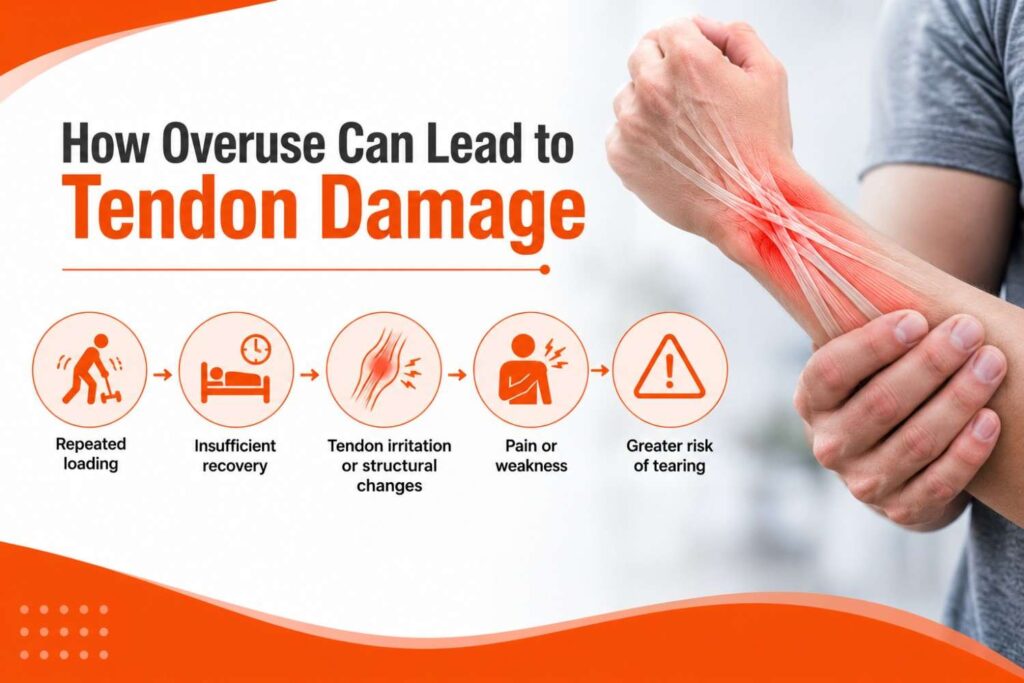
How Overuse Can Lead to Tendon Damage
Repeated movement does not automatically cause a tendon injury.Problems can arise when the amount of stress placed on a tendon repeatedly exceeds its ability to recover and adapt.
A simplified process may look like this:
Repeated loading → insufficient recovery → tendon irritation or structural changes → pain or weakness → continued overload → greater risk of tearing
This is why training progression and recovery are important parts of tendon health.Tendinopathy can involve changes in tendon structure over time rather than a single traumatic event.
Causes of Tendon Injuries in the Hand
The hand is particularly vulnerable to tendon injuries because its tendons are responsible for precise movements.
Common causes of tendon injuries in the hand include:
- Deep cuts
- Broken glass injuries
- Machinery accidents
- Crush injuries
- Sports trauma
- Falls
- Sudden force
- Repetitive gripping
- Occupational strain
Flexor tendons help bend the fingers and thumb, while extensor tendons help straighten them. Damage to either group can interfere with normal hand function.When a deep hand injury is followed by loss of finger movement, professional evaluation is important.
How Can Tendon Injuries Be Prevented?
Not every tendon injury can be prevented, particularly those caused by unexpected accidents. However, several habits may reduce avoidable stress.
Increase Activity Gradually
Avoid making large changes to exercise intensity, duration, or frequency.
Allow Recovery
Give the body appropriate time between demanding activities.
Use Proper Technique
Good movement technique can help distribute forces more effectively.
Strengthen Supporting Muscles
Appropriate strengthening exercises can improve the ability of muscles and tendons to tolerate physical demands.
Use Suitable Equipment
Proper footwear and activity-specific equipment may help reduce unnecessary strain.
Pay Attention to Persistent Symptoms
Pain that repeatedly returns during the same activity should not simply be ignored.
Conclusion
The causes of tendon injuries range from sudden accidents and sports trauma to repetitive stress, heavy physical activity, ageing, and inadequate recovery. Understanding these factors can make it easier to recognise potentially harmful activity patterns and seek assessment when symptoms develop.
A tendon problem should not be judged by pain alone. Weakness, swelling, reduced movement, or sudden loss of function can also be important signs. When a tendon injury follows a deep cut, accident, or sudden force, timely evaluation is especially important.For additional information about breast augmentation procedures and implant safety, visit the American Society of Plastic Surgeons Breast Augmentation Resources.
FREQUENTLY ASKED QUESTIONS

Dr Vinu Roy
Plastic and Cosmetic SurgeonDr Vinu Roy is a plastic and cosmetic surgeon with expertise in cosmetic surgery, reconstructive surgery, microvascular surgery, hand surgery, trauma reconstruction, and brachial plexus procedures.
He focuses on enhancing both form and function with personalized surgical care, helping patients achieve their aesthetic and reconstructive goals with confidence.
Sushrutha Institute of Plastic, Reconstructive, and Aesthetic Surgery, Elite Mission Hospital, Koorkenchery, Thrissur

