
Types of Tendon Injuries
Tendons are strong connective tissues that attach muscles to bones and help produce controlled movement. When a tendon is exposed to excessive force, repeated stress, trauma, or a direct cut, it can become irritated, strained, partially torn, or completely disrupted. Understanding the types of tendon injuries is useful because different injuries can produce different symptoms and may require different approaches to treatment.
A tendon injury can affect the hands, fingers, wrists, shoulders, elbows, knees, ankles, or other parts of the body. Some injuries develop gradually through repetitive loading, while others occur suddenly during sports, accidents, falls, or workplace incidents.
Main Types of Tendon Injuries
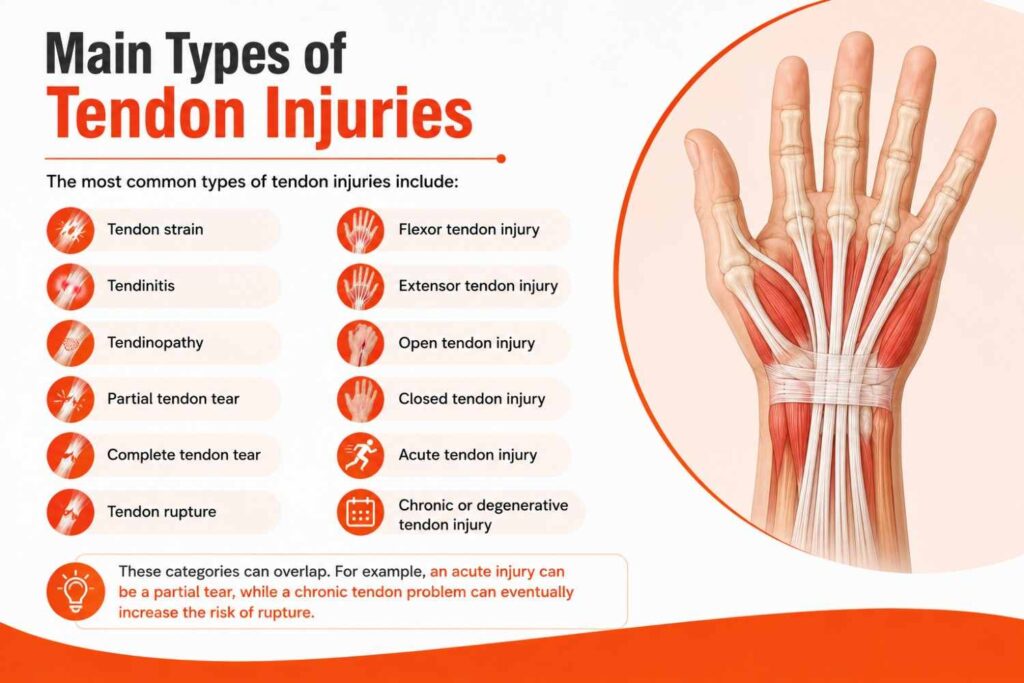
The most common types of tendon injuries include:
- Tendon strain
- Tendinitis
- Tendinopathy
- Partial tendon tear
- Complete tendon tear
- Tendon rupture
- Flexor tendon injury
- Extensor tendon injury
- Open tendon injury
- Closed tendon injury
- Acute tendon injury
- Chronic or degenerative tendon injury
These categories can overlap. For example, an acute injury can be a partial tear, while a chronic tendon problem can eventually increase the risk of rupture.
Tendon Strain
A tendon strain occurs when tendon tissue is stretched or overloaded beyond its normal tolerance.A mild strain may cause discomfort during movement without causing major structural disruption.
Common features may include:
- Localised pain
- Tenderness
- Mild swelling
- Stiffness
- Discomfort during activity
- Reduced tolerance for physical activity
Treatment depends on the severity of the strain and the tendon involved.Reducing aggravating activity and following an appropriate rehabilitation programme may be sufficient for selected mild injuries.
Tendinitis
Tendinitis refers to inflammation of a tendon. It can occur following repetitive activity or sudden overloading.Symptoms may include pain and tenderness near the affected tendon, particularly during movement.
Tendinitis can affect several areas, including:
- Shoulder
- Elbow
- Wrist
- Knee
- Ankle
However, persistent tendon problems are not always caused by inflammation alone. Some longer-term tendon conditions involve structural changes within the tendon and are often described as tendinopathy.
Tendinopathy
Tendinopathy is a broader term used for tendon pain and dysfunction associated with tendon changes.It often develops gradually and can be associated with repetitive loading or overuse.
A person may notice:
- Pain during activity
- Stiffness
- Reduced strength
- Tenderness
- Reduced exercise tolerance
- Discomfort that returns with repeated activity
Tendinopathy can affect athletes, manual workers, and people whose daily activities repeatedly load a particular tendon.Managing the underlying activity and gradually rebuilding tendon capacity are important aspects of rehabilitation.
Partial Tendon Tear
A partial tendon tear occurs when some tendon fibres are damaged while part of the tendon remains intact.Among the different types of tendon injuries, partial tears can sometimes be difficult to recognise because the affected body part may still be capable of movement.
Possible symptoms include:
- Pain
- Swelling
- Weakness
- Tenderness
- Reduced movement
- Discomfort during loading
The severity of a partial tear can vary considerably. Some may respond to conservative management, while others may require more specialised treatment.A physical examination and, when appropriate, imaging can help determine the extent of damage.
Complete Tendon Tear
A complete tendon tear means the tendon has been disrupted across its full thickness.The resulting loss of tendon continuity can significantly affect movement.For example, a complete tendon injury in the hand may prevent normal bending or straightening of a finger.
Possible signs include:
- Sudden pain
- Loss of strength
- Significant weakness
- Reduced or absent movement
- Swelling
- Bruising
- A popping or snapping sensation
Treatment depends on the tendon involved, location of the tear, cause of injury, and the individual’s functional requirements.
Tendon Rupture
A tendon rupture is a significant disruption in the tendon, often resulting from sudden force or a tendon that has become vulnerable through degeneration.A rupture can occur during sports, physical activity, falls, or other traumatic events.The Achilles tendon is one well-known example. Achilles tendon rupture may cause sudden pain, swelling, difficulty walking, and difficulty pushing off with the affected foot.Other tendons can also rupture, including tendons around the shoulder, knee, hand, and elbow.
Flexor Tendon Injury
Flexor tendons help bend the fingers, thumb, and wrist.Injuries to these tendons are particularly important in hand trauma because damage can interfere with gripping and finger movement.Flexor tendon injuries can result from:
- Deep cuts
- Glass injuries
- Crush injuries
- Sports trauma
- Workplace accidents
Possible signs include difficulty bending one or more fingers, pain, swelling, and reduced grip function.A deep cut that causes sudden loss of finger movement requires prompt assessment.
Extensor Tendon Injury
Extensor tendons help straighten the fingers and thumb.They can be injured by cuts, trauma, sports injuries, or forceful movements.A person with an extensor tendon injury may have difficulty fully straightening the affected finger or thumb.Treatment depends on the location and extent of the injury. Some extensor tendon injuries can be managed with splinting, while others may require surgical repair.
Open Tendon Injury
An open tendon injury occurs when the tendon is damaged through a wound in the skin.Deep cuts to the hand or wrist are common examples.These injuries require particular attention because the same accident can damage:
- Tendons
- Nerves
- Blood vessels
- Bones
- Skin
- Other soft tissues
The wound may look relatively small externally while deeper structures are significantly affected.For this reason, movement loss following a deep wound should be professionally evaluated rather than repeatedly tested at home.
Closed Tendon Injury
A closed tendon injury occurs without an open wound exposing the injured tendon.These injuries can develop through:
- Sports trauma
- Falls
- Sudden force
- Overuse
- Repetitive loading
- Direct impact
A closed injury may still cause a significant tendon tear or rupture.The absence of a visible wound does not necessarily mean the injury is minor.
Acute Tendon Injuries
Acute tendon injuries develop suddenly, often following a specific event.
Examples include:
- Sports injuries
- Falls
- Sudden lifting
- Road accidents
- Crush injuries
- Deep cuts
- Sudden forceful movements
Symptoms often begin immediately and may include pain, swelling, weakness, or loss of movement.Acute injuries require assessment when there is significant functional loss or suspected structural damage.
Chronic Tendon Injuries
Chronic tendon problems develop gradually and may continue for weeks or months.They are often associated with repetitive loading, insufficient recovery, or persistent mechanical stress.Symptoms can include:
- Recurring pain
- Stiffness
- Reduced strength
- Tenderness
- Reduced physical performance
- Pain that returns with activity
Long-standing tendon problems may require a structured rehabilitation programme rather than simply resting for a few days.
Sports-Related Tendon Injuries
Sports are associated with both acute and overuse tendon injuries.Activities involving repeated running, jumping, throwing, gripping, or rapid changes in direction can place substantial demands on tendons.Common contributing factors include:
- Sudden training increases
- Inadequate recovery
- Repetitive movements
- Poor technique
- Previous injuries
- High training loads
For example, Achilles tendon rupture is commonly associated with sudden force during running and jumping activities.
Tendon Injuries in the Hand
The hand contains numerous tendons that control precise movements.Some of the important types of tendon injuries affecting the hand include flexor tendon injuries and extensor tendon injuries.
They may result from:
- Deep cuts
- Broken glass
- Machinery accidents
- Crush injuries
- Sports injuries
- Falls
A hand tendon injury can affect basic activities such as gripping, writing, dressing, cooking, or using tools.Because tendons may be located close to nerves and blood vessels, a thorough assessment can be important after significant hand trauma.
How Are Different Tendon Injuries Diagnosed?
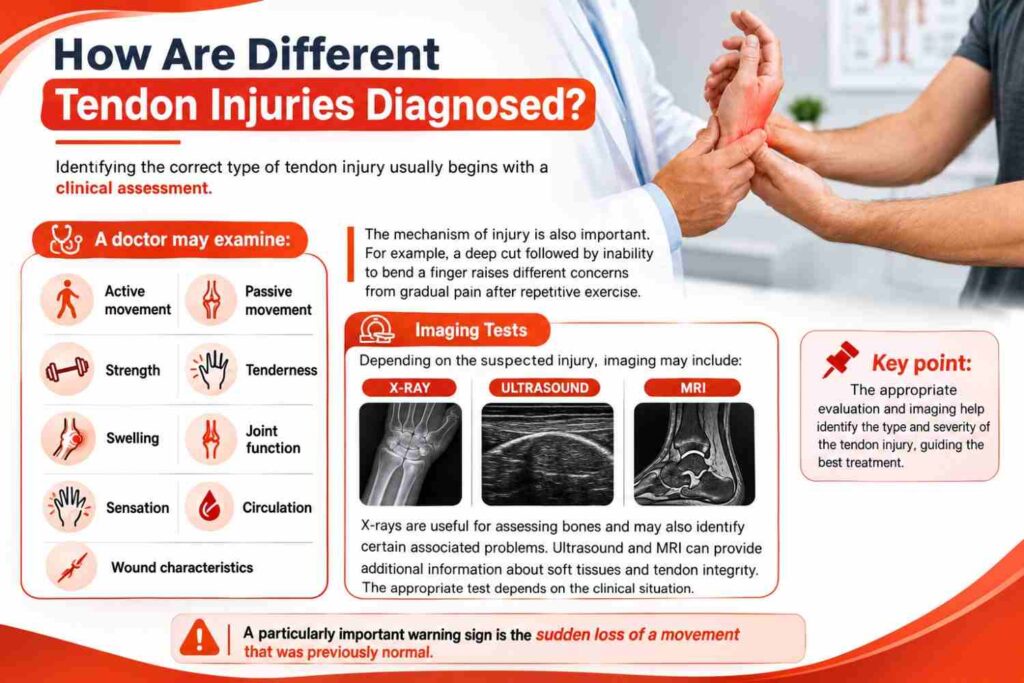
Identifying the correct type of tendon injury usually begins with a clinical assessment.
A doctor may examine:
- Active movement
- Passive movement
- Strength
- Tenderness
- Swelling
- Joint function
- Sensation
- Circulation
- Wound characteristics
The mechanism of injury is also important.For example, a deep cut followed by inability to bend a finger raises different concerns from gradual pain after repetitive exercise.
Imaging Tests
Depending on the suspected injury, imaging may include:
- X-ray
- Ultrasound
- MRI
X-rays are useful for assessing bones and may also identify certain associated problems. Ultrasound and MRI can provide additional information about soft tissues and tendon integrity.The appropriate test depends on the clinical situation.
When Should You Seek Medical Attention?
Some tendon problems can be managed conservatively, but certain signs require prompt evaluation.
Seek medical attention if you experience:
- Sudden loss of movement
- Inability to bend or straighten a finger
- Significant weakness following trauma
- A deep cut near a joint
- Sudden swelling after an injury
- A popping sensation followed by weakness
- Persistent symptoms affecting daily activities
- Suspected tendon rupture
Early evaluation is particularly important when a tendon injury occurs alongside possible nerve, blood vessel, bone, or skin damage.
How Can Tendon Injuries Be Prevented?
Not every tendon injury can be prevented, especially those caused by unexpected accidents. However, several habits may help reduce avoidable tendon stress.
Increase Exercise Gradually
Avoid sudden increases in exercise intensity or duration.
Use Appropriate Technique
Proper technique can help distribute physical forces more effectively.
Allow Adequate Recovery
Tendons need time to adapt to repeated physical loading.
Use Suitable Equipment
Activity-specific equipment and appropriate footwear may help reduce unnecessary strain.
Address Persistent Pain
Recurring pain should not simply be ignored, particularly if it affects movement or performance.
Conclusion
Understanding the different types of tendon injuries can make it easier to recognise why symptoms and treatment approaches vary from one person to another. Tendon problems may range from overuse-related conditions and strains to partial tears, complete ruptures, and traumatic hand injuries.
A tendon injury accompanied by sudden weakness, loss of movement, a deep cut, or significant trauma should be evaluated by a qualified healthcare professional. Accurate diagnosis helps determine whether rehabilitation, splinting, observation, or surgical treatment may be appropriate. For additional information about breast augmentation procedures and implant safety, visit the American Society of Plastic Surgeons Breast Augmentation Resources.
FREQUENTLY ASKED QUESTIONS

Dr Vinu Roy
Plastic and Cosmetic SurgeonDr Vinu Roy is a plastic and cosmetic surgeon with expertise in cosmetic surgery, reconstructive surgery, microvascular surgery, hand surgery, trauma reconstruction, and brachial plexus procedures.
He focuses on enhancing both form and function with personalized surgical care, helping patients achieve their aesthetic and reconstructive goals with confidence.
Sushrutha Institute of Plastic, Reconstructive, and Aesthetic Surgery, Elite Mission Hospital, Koorkenchery, Thrissur

