

When Should You Start Physiotherapy After Hand Surgery?
One of the most common questions patients ask after an operation is: when should you start physiotherapy after hand surgery? The honest answer is that timing depends on the type of surgery, the tissues involved, and how well the hand is healing. Getting this timing right matters, because starting physiotherapy after hand surgery too early can disturb healing tissue, while starting too late can lead to stiffness that is hard to reverse. Patients travelling to Thrissur for hand surgery often want a clear, practical answer rather than vague advice, so this guide breaks down exactly when and how physiotherapy fits into recovery.
The hand is a complex structure of bones, tendons, nerves, ligaments, and soft tissue, and every one of these responds differently to movement. That is why there is no single fixed day on which physiotherapy after hand surgery begins for everyone. Instead, the surgeon and physiotherapist work together, reviewing the healing stage before deciding the right time to begin exercises.
What Does Physiotherapy After Hand Surgery Actually Involve?
Physiotherapy after hand surgery is a structured programme of movement, stretching, strengthening, and sensory retraining designed to restore function to the hand. It is not just about moving fingers — it involves guided exercises, splinting adjustments, scar management, swelling control, and gradual reintroduction of daily tasks.
The goal of physiotherapy after hand surgery is simple: help the hand regain as much movement, strength, and sensation as possible while protecting the repair underneath. A physiotherapist works closely with the operating surgeon, adjusting the plan based on what was repaired — bone, tendon, nerve, ligament, or soft tissue.

When Should You Start Physiotherapy After Hand Surgery?
This is the central question, and the answer varies by procedure:
- Fracture fixation (plates, screws, wires): Gentle movement often begins within the first 1–2 weeks once swelling settles and the surgeon confirms the fixation is stable.
- Tendon repair: Early protected motion, guided closely by a physiotherapist, may start around days 3–5, using specific splint-based protocols to avoid stressing the repair.
- Nerve repair: Movement is usually delayed slightly longer, often starting around 2–3 weeks, with sensory retraining introduced later as nerve regeneration progresses.
- Ligament repair or joint reconstruction: Physiotherapy generally starts once the joint is protected in a splint, often between 2–4 weeks depending on stability.
- Soft-tissue reconstruction (grafts or flaps): Movement is introduced cautiously once the tissue has shown healthy healing, sometimes after 2–3 weeks.
In every case, the decision on when should you start physiotherapy after hand surgery rests with the treating surgeon, based on wound healing, stability of repair, and absence of infection.
Why Timing Cannot Be Rushed
Starting physiotherapy after hand surgery before tissues are ready can stretch or rupture a tendon repair, disturb a healing fracture, or damage a nerve graft. However, delaying physiotherapy after hand surgery unnecessarily can allow scar tissue to build up around joints and tendons, causing stiffness that becomes harder to treat later. This is why physiotherapy after hand surgery is planned in phases rather than left to guesswork. The right time to begin physiotherapy after hand surgery depends on the type of procedure, the tissues involved, and the surgeon’s healing assessment.
Common Causes of Delayed or Difficult Recovery
Certain factors make the recovery period longer and make careful physiotherapy timing even more important:
- Crush injuries involving multiple structures at once
- Infection at the surgical site
- Poor wound healing due to diabetes or circulation issues
- Delayed presentation after the original injury
- Repeated surgeries on the same hand
- Poor compliance with splinting instructions
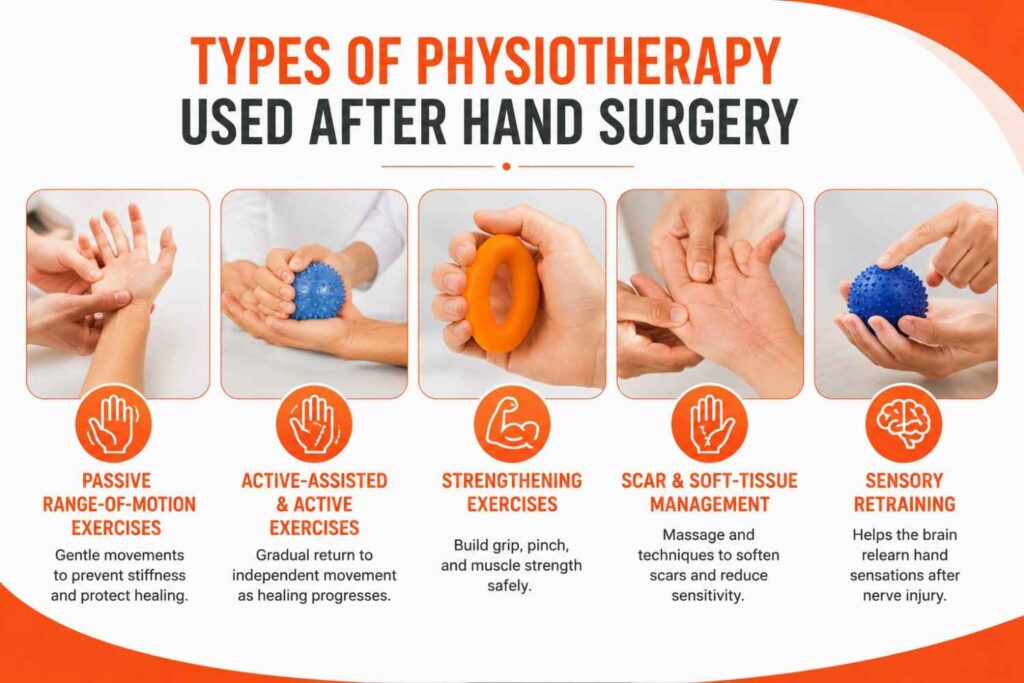
Types of Physiotherapy Used After Hand Surgery
Passive Range-of-Motion Exercises
In early recovery, a physiotherapist may gently move the joint through its range without the patient using muscle effort. This protects healing tissue while still preventing stiffness.
Active-Assisted and Active Exercises
As healing progresses, patients begin moving the hand themselves, sometimes with light assistance, gradually building toward independent movement.
Strengthening Exercises
Once tissues are stable, grip and pinch strengthening exercises are introduced to rebuild muscle power lost during immobilisation.
Scar and Soft-Tissue Management
Massage and desensitisation techniques help soften scar tissue and reduce sensitivity, which is an important part of physiotherapy after hand surgery.
Sensory Retraining
For nerve injuries, sensory retraining exercises help the brain relearn how to interpret signals from the hand as the nerve regenerates.
Symptoms and Signs That Physiotherapy Should Begin
A physiotherapist and surgeon typically look for these signs before advancing physiotherapy after hand surgery:
- Reduced swelling around the surgical site
- Stable wound closure with no signs of infection
- Confirmed stability of the repair on examination or imaging
- Manageable pain levels
- Surgeon’s clearance at the follow-up review
Benefits of Starting Physiotherapy at the Right Time
- Prevents joint stiffness and tendon adhesions
- Restores grip strength and coordination faster
- Protects sensation and reduces numbness
- Lowers the risk of long-term deformity
- Supports quicker return to work and daily activities
- Improves overall confidence in using the hand again
Choosing the Right Team for Physiotherapy After Hand Surgery
Recovery works best when the hand surgeon and physiotherapist coordinate closely. Look for a team that explains the healing stage clearly, adjusts the plan based on your specific repair, and communicates openly about when should you start physiotherapy after hand surgery in your particular case. A physiotherapist experienced in hand injuries — not general orthopaedic rehabilitation alone — makes a meaningful difference to outcomes.
Conclusion
So, when should you start physiotherapy after hand surgery? There is no single answer that fits every patient — it depends on what was repaired, how the tissue is healing, and the surgeon’s assessment at each follow-up. What matters most is that physiotherapy after hand surgery is neither rushed nor delayed, but introduced in careful, guided phases that protect the repair while restoring movement, strength, and sensation. Patients recovering from hand surgery in Thrissur are encouraged to stay closely connected with their surgical and physiotherapy team, follow the recommended timeline, and raise any concerns early, so that the hand can return to its fullest possible function over time. For additional information about breast augmentation procedures and implant safety, visit the American Society of Plastic Surgeons Breast Augmentation Resources.
FREQUENTLY ASKED QUESTIONS

Dr Vinu Roy
Plastic and Cosmetic SurgeonDr Vinu Roy is a plastic and cosmetic surgeon with expertise in cosmetic surgery, reconstructive surgery, microvascular surgery, hand surgery, trauma reconstruction, and brachial plexus procedures.
He focuses on enhancing both form and function with personalized surgical care, helping patients achieve their aesthetic and reconstructive goals with confidence.
Sushrutha Institute of Plastic, Reconstructive, and Aesthetic Surgery, Elite Mission Hospital, Koorkenchery, Thrissur

