

When Can You Return to Work After a Hand Injury?
A hand injury can temporarily affect your ability to type, write, lift, grip, drive, use tools, or perform repetitive tasks. When can you return to work after a hand injury? The answer depends on the type of injury, treatment received, healing progress, and demands of your job. Even a relatively small injury can require time before normal work activities are safe.
If you are wondering when can you return to work after a hand injury, it is important to understand that recovery is not the same for everyone. A simple soft-tissue injury may improve within days or weeks, while a fracture, tendon injury, nerve injury, or complex wound may require a much longer recovery period.
Returning to work too early may place stress on healing tissues. On the other hand, staying inactive for longer than necessary may contribute to stiffness and reduced strength. The goal is to find a safe balance between healing and gradually restoring normal activity.
When Can You Return to Work After a Hand Injury?
The most important factor determining when can you return to work after a hand injury is the nature of the injury.
A person with a minor cut may return to light duties relatively quickly. Someone who has undergone tendon repair may need considerably more protection before using the affected hand normally.
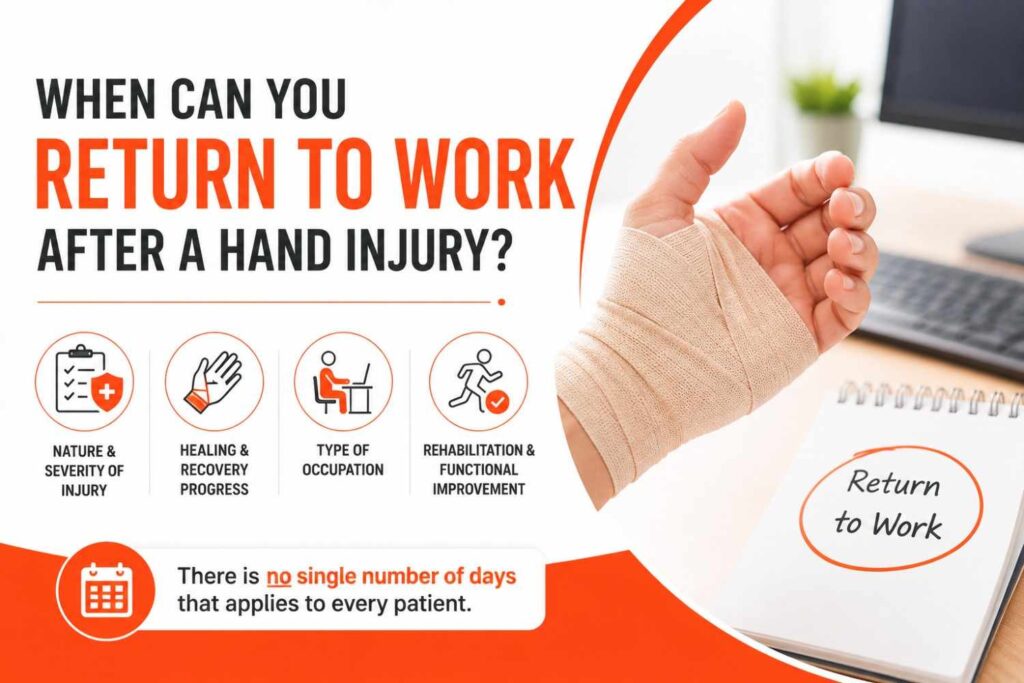
Your recovery may depend on:
- Type of hand injury
- Location of the injury
- Severity of tissue damage
- Whether surgery was performed
- Bone healing
- Tendon healing
- Nerve recovery
- Wound condition
- Pain and swelling
- Grip strength
- Finger movement
- Type of occupation
- Rehabilitation progress
Therefore, there is no single number of days that applies to every patient.
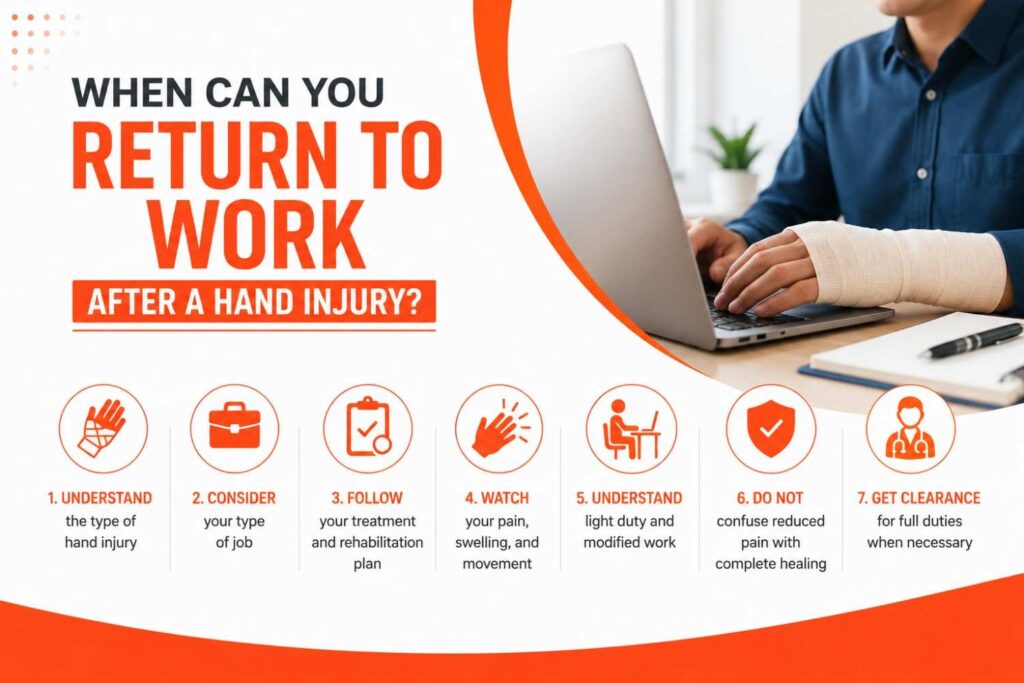
1. Understand the Type of Hand Injury
One of the first steps in understanding when can you return to work after a hand injury is identifying what has actually been injured.
The hand contains several structures that work together. Damage to one structure can affect the function of another.
- Minor Soft-Tissue Injuries
Mild bruises, strains, and superficial wounds may improve relatively quickly. Some people may resume light activities once pain and swelling decrease.
However, repetitive work, heavy lifting, or forceful gripping may need to be avoided temporarily.
- Hand Fractures
A fractured finger, hand bone, or wrist may require splinting, casting, or surgery. Returning to work depends on fracture stability and whether your job places stress on the affected area.
A person with an office-based job may sometimes return to modified duties sooner than someone who performs manual labour.
- Tendon Injuries
Tendons are responsible for moving the fingers and wrist. After tendon repair, the repaired tissue needs protection while it heals.
Even if pain decreases quickly, this does not necessarily mean the tendon is strong enough for normal work.
- Nerve Injuries
Nerve injuries may cause numbness, tingling, weakness, or reduced coordination. Recovery can take longer than expected because nerve healing may be gradual.
Jobs involving machinery, sharp objects, heat, or heavy equipment may require particular caution when sensation is reduced.
2. Consider Your Type of Job
The question when can you return to work after a hand injury also depends heavily on what your work requires.
A person who works at a computer may have different restrictions from someone who works in construction.
- Office and Computer Work
Office work may involve:
- Typing
- Writing
- Using a mouse
- Handling documents
- Holding a phone
- Repetitive finger movements
If the injured hand is painful or immobilised, these activities may initially be difficult.
Modified work may include shorter typing periods, additional breaks, voice-to-text tools, or using the unaffected hand where appropriate.
- Manual Work
Manual jobs can place considerably greater demands on the hand.
Examples include:
- Construction
- Carpentry
- Plumbing
- Electrical work
- Manufacturing
- Warehouse work
- Mechanical work
- Food preparation
These occupations may require lifting, gripping, pushing, pulling, vibration exposure, and repetitive movements.
For such workers, when can you return to work after a hand injury may be considerably later than for someone performing sedentary work.
- Jobs Requiring Fine Hand Movements
Some occupations require precise finger coordination.
These include:
- Surgeons
- Dentists
- Musicians
- Artists
- Tailors
- Technicians
- Laboratory workers
- Craftspeople
A person may need good coordination and finger control before returning to full professional duties.
3. Follow Your Treatment and Rehabilitation Plan
A structured recovery plan can help determine when can you return to work after a hand injury.
Treatment may include:
- Splinting
- Casting
- Wound care
- Medication
- Surgery
- Physiotherapy
- Occupational therapy
- Range-of-motion exercises
- Strengthening exercises
- Scar management
- Sensory rehabilitation
The rehabilitation programme should match the injury.
For example, aggressive movement may be inappropriate immediately after certain tendon repairs, while prolonged immobilisation may cause stiffness in some other injuries.
This is why exercises should be performed according to the instructions provided by your treating specialist or therapist.
4. Watch Your Pain, Swelling, and Movement
Pain and swelling can provide useful information during recovery.
If normal work activities cause increasing pain or swelling, your hand may not yet be ready for that level of activity.
Before returning to regular duties, you may need improvement in:
- Pain
- Swelling
- Finger movement
- Wrist movement
- Grip
- Coordination
- Wound healing
- Sensation
However, symptoms alone should not determine your return-to-work date.
A hand can sometimes feel better before internal tissues have completely healed. This is particularly important after surgery or significant tendon, ligament, nerve, or bone injuries.
5. Understand Light Duty and Modified Work
Returning to work does not always mean immediately returning to your full workload.
One useful approach is a gradual return.
Depending on the injury, modified duties may include:
- Reduced lifting
- Avoiding forceful gripping
- Shorter working periods
- More frequent breaks
- Reduced repetitive hand movements
- Avoiding vibrating tools
- Avoiding heavy machinery
- Using the unaffected hand where possible
- Temporary administrative duties
This can allow you to remain active while protecting healing tissues.
If you are asking when can you return to work after a hand injury, ask your treating specialist whether modified duties could be appropriate before full duties.
6. Do Not Confuse Reduced Pain With Complete Healing
One common mistake after a hand injury is assuming that less pain means complete recovery.
Pain can decrease before:
- Bone strength is fully restored
- Tendons regain adequate strength
- Nerves recover
- Soft tissues become stable
- Grip strength returns
- Coordination improves
For this reason, returning to heavy work simply because the hand feels better may increase the risk of reinjury.
The safe return-to-work decision should consider healing, function, examination findings, and the requirements of your occupation.
7. Get Clearance for Full Duties When Necessary
For more serious injuries, your treating specialist may assess your hand before allowing unrestricted work.
The assessment may consider:
- Range of motion
- Grip strength
- Pinch strength
- Sensation
- Wound healing
- Joint stability
- Tendon function
- Bone healing
- Pain levels
- Swelling
- Work requirements
This is especially important when your job involves heavy lifting, machinery, repetitive movements, or a high risk of reinjury.
How Long Does It Take to Return to Work After a Hand Injury?
There is no universal recovery timeline.
Some minor injuries may allow a person to resume selected duties within a short period. More significant injuries can require several weeks or months.
Minor Injuries
For a minor injury, work may resume once:
- Pain is manageable
- Swelling is controlled
- Movement is adequate
- The wound is healing
- Work activities do not interfere with recovery
Fractures
A fracture generally needs time for bone healing and functional recovery. The timeline varies according to the bone involved, fracture pattern, treatment, and occupation.
Tendon Repairs
Tendon healing requires careful protection and rehabilitation. Returning to forceful gripping or heavy manual work may take considerably longer than returning to light duties.
Nerve Injuries
Nerve recovery may be prolonged. Even after the wound has healed, sensation and strength may continue to improve over time.
Complex Hand Injuries
Severe crush injuries, multiple-structure injuries, or injuries requiring reconstruction may need a longer rehabilitation programme.
What Factors Can Delay Your Return to Work?
Several factors can make recovery slower.
Severity of the Injury
A complex injury involving multiple structures usually requires more recovery time than an isolated minor injury.
Infection
Infection can interfere with wound healing and may require additional treatment.
Smoking
Smoking can negatively affect tissue healing and may interfere with recovery after certain injuries or surgical procedures.
Poor Rehabilitation
Avoiding prescribed rehabilitation may contribute to stiffness, weakness, or reduced function.
Returning to Heavy Activity Too Early
Excessive loading before tissues are ready may increase pain or interfere with healing.
Complications
Some injuries may develop complications such as stiffness, persistent swelling, scar problems, infection, or reduced movement.
Signs You May Not Be Ready for Full Work
If you are considering returning to work, be cautious if you still have:
- Significant pain
- Increasing swelling
- Severe stiffness
- Weak grip
- Poor finger control
- Numbness
- Tingling
- Wound discharge
- Persistent wound problems
- Difficulty holding objects
- Difficulty performing essential job tasks
These symptoms do not automatically mean you cannot work, but they may indicate that your current workload needs modification or that another assessment is appropriate.
What Happens If You Return to Work Too Early?
Returning too soon can place unnecessary stress on healing tissues.
Potential problems may include:
- Increased pain
- Increased swelling
- Reinjury
- Wound problems
- Reduced movement
- Delayed recovery
- Damage to a healing repair
This does not mean that complete inactivity is always necessary. The important point is to follow an appropriate activity progression.
Conclusion
Understanding when can you return to work after a hand injury requires more than looking at the number of days since the accident or surgery. Recovery depends on the injured structures, treatment, healing progress, rehabilitation, symptoms, and physical demands of your occupation.
A gradual return to work can often be safer than immediately resuming every normal activity. Light duties, reduced lifting, regular breaks, and temporary restrictions may help protect the healing hand while allowing you to remain active.
If you are still experiencing significant pain, weakness, numbness, swelling, limited movement, or difficulty performing your normal work tasks, seek professional assessment before increasing your workload. Knowing when can you return to work after a hand injury and following an appropriate recovery plan can help protect hand function and support a safer return to everyday activities.
For patients considering when can you return to work after a hand injury, proper evaluation, rehabilitation, and follow-up are particularly important when the injury involves tendons, nerves, bones, joints, or complex soft tissues.For additional information about breast augmentation procedures and implant safety, visit the American Society of Plastic Surgeons Breast Augmentation Resources.
FREQUENTLY ASKED QUESTIONS

Dr Vinu Roy
Plastic and Cosmetic SurgeonDr Vinu Roy is a plastic and cosmetic surgeon with expertise in cosmetic surgery, reconstructive surgery, microvascular surgery, hand surgery, trauma reconstruction, and brachial plexus procedures.
He focuses on enhancing both form and function with personalized surgical care, helping patients achieve their aesthetic and reconstructive goals with confidence.
Sushrutha Institute of Plastic, Reconstructive, and Aesthetic Surgery, Elite Mission Hospital, Koorkenchery, Thrissur

