
10 Critical Signs Your Hand Injury Needs Immediate Medical Attention
Knowing the signs your hand injury needs immediate medical attention can help you respond appropriately after an accident, cut, fall, crush injury, or sports-related trauma. Some hand injuries may appear minor initially but can involve deeper structures such as tendons, nerves, bones, joints, or blood vessels. In Thrissur, prompt assessment can help determine whether a hand injury requires urgent treatment, observation, or specialist care.
The hand performs many precise movements every day. Even a small problem affecting a tendon, nerve, joint, or bone can interfere with gripping, writing, typing, dressing, working, and other routine activities.
Not every hand injury requires emergency treatment. However, certain warning signs should not be ignored.
Why Some Hand Injuries Need Immediate Attention
A hand injury can affect several structures at once.
For example, a deep cut may damage:
- Skin
- Tendons
- Nerves
- Blood vessels
- Joints
- Bone
A crush injury can also affect multiple tissues simultaneously.
The visible wound may therefore provide only part of the picture.
Recognizing the signs your hand injury needs immediate medical attention can help you know when professional assessment is necessary.
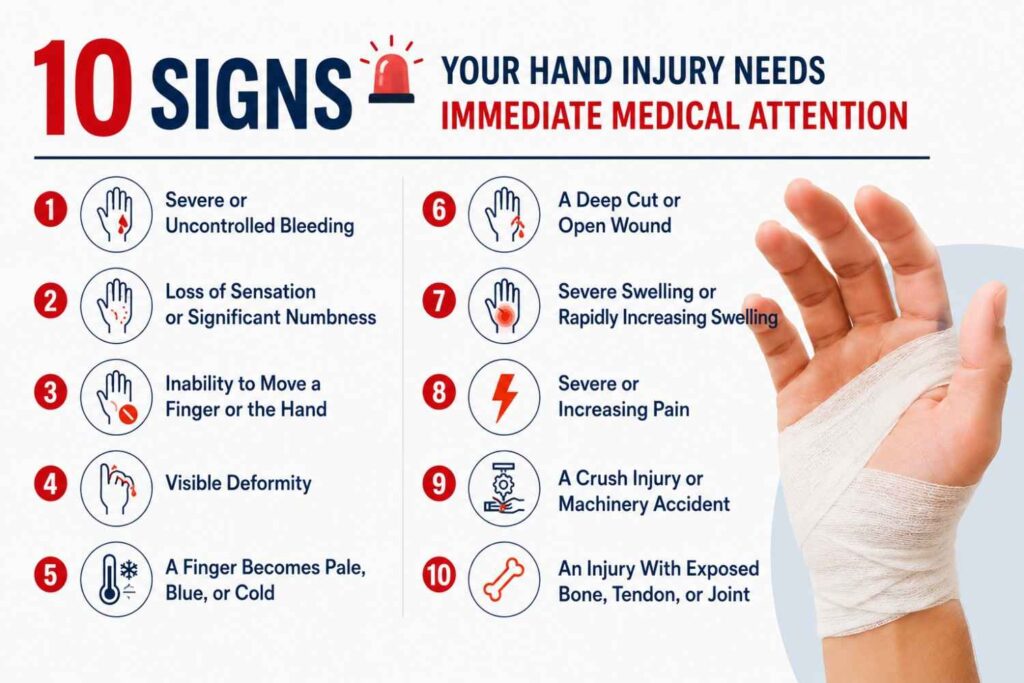
10 Signs Your Hand Injury Needs Immediate Medical Attention
1. Severe or Uncontrolled Bleeding
One of the clearest signs your hand injury needs immediate medical attention is bleeding that is severe or does not stop with appropriate direct pressure.
The hand contains many blood vessels, and deeper injuries can damage arteries or other vessels.
Seek urgent medical care when:
- Bleeding is heavy
- Blood continues despite sustained pressure
- The wound appears deep
- Blood is rapidly soaking through dressings
- The injury involves a major cut or crush
Do not repeatedly remove a dressing to check the wound if bleeding continues. Appropriate first aid and urgent medical evaluation may be necessary.
2. Loss of Sensation or Significant Numbness
Sudden or persistent numbness after an injury can indicate nerve involvement.
This is particularly concerning after:
- Deep cuts
- Crush injuries
- Dislocations
- Fractures
- Machinery accidents
You may notice that a finger or part of the hand feels different from the other side.
Reduced sensation can also increase the risk of accidental burns or other injuries because the affected area may not properly detect temperature or pain.
Persistent numbness is therefore among the important signs your hand injury needs immediate medical attention.
3. Inability to Move a Finger or the Hand
Being unable to move a finger after an injury should be assessed promptly.
Possible causes can include:
- Tendon injury
- Fracture
- Dislocation
- Nerve damage
- Severe swelling
- Joint injury
For example, a person with a tendon injury may be unable to actively bend or straighten a particular finger.
Do not repeatedly force the finger to move in an attempt to test it.
A medical examination can help determine which structure has been affected.
4. Visible Deformity
A finger or hand that appears crooked, shortened, displaced, or unusually positioned may indicate a fracture or dislocation.
A visible deformity is one of the signs your hand injury needs immediate medical attention because the bones or joints may no longer be in their normal alignment.
Trying to straighten a visibly deformed finger yourself can cause additional injury.
Instead, protect the hand and seek appropriate medical care.
5. A Finger Becomes Pale, Blue, or Cold
Changes in finger colour or temperature can indicate a problem with blood flow.
A healthy finger generally has appropriate circulation and should not suddenly become:
- Pale
- Blue
- Grey
- Unusually cold
This can be particularly concerning after a severe crush injury, fracture, dislocation, or wound.
Changes in circulation should be assessed urgently because tissues require adequate blood supply to remain healthy.
6. A Deep Cut or Open Wound
A deep cut should not be judged only by its length.
A wound may extend into deeper structures even if the opening in the skin does not appear large.
Deep wounds can potentially involve:
- Tendons
- Nerves
- Blood vessels
- Joints
- Bone
A particularly important warning sign is a deep wound associated with numbness or difficulty moving the fingers.
This combination may suggest that structures beneath the skin have been injured.
7. Severe Swelling or Rapidly Increasing Swelling
Some swelling is common after an injury.
However, rapidly increasing or severe swelling should receive medical attention, particularly when it occurs with:
- Severe pain
- Numbness
- Reduced movement
- Colour changes
- Tightness
- Weakness
Swelling can occur with fractures, crush injuries, bleeding into tissues, and other significant trauma.
The combination of swelling and neurological or circulation changes is especially important.
8. Severe or Increasing Pain
Pain is common after a hand injury, but severe or progressively worsening pain can be a warning sign.
Pain that becomes significantly worse rather than gradually improving may require assessment.
Pay particular attention when severe pain occurs alongside:
- Swelling
- Numbness
- Weakness
- Colour changes
- Loss of movement
- Significant trauma
The severity and pattern of pain can help a doctor understand the nature of the injury.
9. A Crush Injury or Machinery Accident
Crush injuries deserve careful evaluation because the damage may extend beyond the visible skin injury.
A hand caught in:
- Machinery
- A vehicle
- A heavy door
- Industrial equipment
- A heavy object
may experience damage to several tissues simultaneously.
Possible injuries include:
- Fractures
- Tendon damage
- Nerve injury
- Blood vessel damage
- Muscle injury
- Soft-tissue damage
A crush injury is therefore one of the signs your hand injury needs immediate medical attention, even when the external wound does not appear dramatic.
10. An Injury With Exposed Bone, Tendon, or Joint
If a wound exposes deeper structures, immediate medical assessment is necessary.
Visible bone, tendon, or joint structures indicate a significant open injury.
These wounds can have a higher risk of infection and may require specialist wound management, surgical treatment, or reconstruction.
Do not attempt to push exposed tissue back into the wound.
Cover the area appropriately with a clean dressing if possible and seek urgent medical care.
Other Warning Signs You Should Not Ignore
The 10 main signs your hand injury needs immediate medical attention are not the only reasons to seek care.
Other concerning situations include:
- An animal or human bite
- A heavily contaminated wound
- A foreign object embedded in the hand
- A suspected fracture
- A suspected dislocation
- Significant burns
- Electrical injuries
- Loss of grip strength
- New weakness
- Persistent tingling
- Increasing redness or discharge
- Fever following an open wound
The appropriate level of treatment depends on the type and severity of the injury.
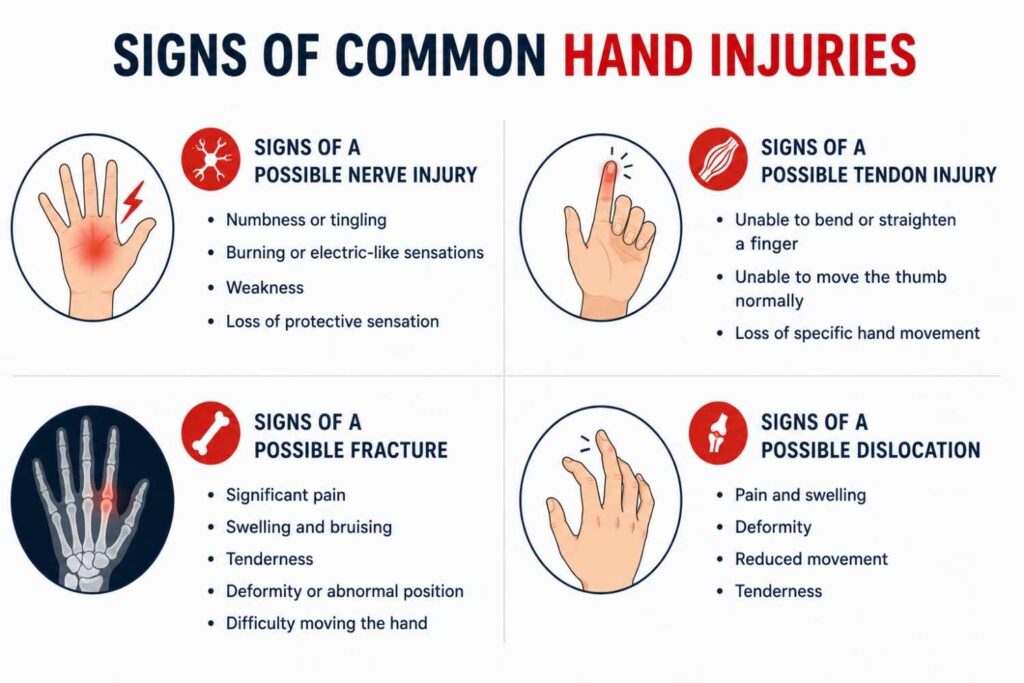
Signs of a Possible Nerve Injury
Nerves help the hand detect sensation and control certain movements.
A nerve injury may produce:
- Numbness
- Tingling
- Burning
- Electric-like sensations
- Weakness
- Reduced coordination
- Loss of protective sensation
If these symptoms appear after a significant injury, particularly a deep cut or crush injury, medical evaluation is important.
A nerve can be bruised, stretched, compressed, or cut.
The treatment and recovery process depends on the severity of the damage.
Signs of a Possible Tendon Injury
Tendons connect muscles to bones and allow the fingers and wrist to move.
A tendon injury may be suspected when a person cannot actively:
- Bend a finger
- Straighten a finger
- Move the thumb normally
- Perform a specific hand movement
A deep cut over the path of a tendon combined with loss of movement should be assessed promptly.
Signs of a Possible Fracture
A fracture may produce:
- Significant pain
- Swelling
- Bruising
- Tenderness
- Deformity
- Difficulty moving the hand
- Abnormal finger position
Some fractures are obvious, while others require imaging for confirmation.
Do not assume that the absence of a visible deformity means that there is no fracture.
Signs of a Possible Dislocation
A dislocated finger or joint may look abnormal and may be difficult to move.
Other symptoms can include:
- Pain
- Swelling
- Deformity
- Reduced movement
- Tenderness
A suspected dislocation should be evaluated rather than forcibly repositioned at home.
What Should You Do Before Reaching Medical Care?
When a significant hand injury occurs, the immediate priority is to protect the hand and obtain appropriate care.
General first-aid measures may include:
- Move away from the source of injury.
- Apply appropriate direct pressure to significant bleeding.
- Keep the injured hand protected.
- Avoid unnecessary movement.
- Remove rings or tight jewellery if swelling is developing and they can be removed safely.
- Do not attempt to straighten a deformed finger.
- Do not force movement through severe pain.
- Do not attempt to repair a deep wound yourself.
- Seek urgent medical assessment for serious injuries.
The appropriate first-aid response depends on the specific injury.
How Early Treatment Can Support Recovery
Prompt treatment can help establish a clear recovery plan.
Depending on the injury, this may include:
- Wound management
- Splinting
- Fracture treatment
- Surgical repair
- Medication
- Physiotherapy
- Hand therapy
- Sensory rehabilitation
- Strengthening
- Follow-up monitoring
The recovery period varies significantly between injuries.
A simple injury may improve relatively quickly, while complex trauma involving nerves, tendons, bones, or multiple structures may require a longer rehabilitation process.
Conclusion
Knowing the signs your hand injury needs immediate medical attention can help you make a safer decision after an accident. Severe bleeding, numbness, loss of movement, deformity, circulation changes, deep wounds, significant swelling, worsening pain, crush injuries, and exposed deeper structures should not be ignored.
A hand injury can affect more than the skin. Tendons, nerves, bones, joints, blood vessels, and soft tissues may also be involved. Because these structures work together, an injury that is not properly assessed can potentially affect everyday hand function.
Not every injury requires surgery, and some minor injuries may improve with appropriate basic care. However, recognizing warning signs early allows significant injuries to be evaluated and treated appropriately.
For patients in Thrissur, prompt specialist assessment after a serious hand injury can help identify the extent of damage and guide treatment. If you notice any of the signs your hand injury needs immediate medical attention, particularly loss of sensation, movement, circulation, or significant bleeding, seek appropriate medical care without unnecessary delay.For additional information about breast augmentation procedures and implant safety, visit the American Society of Plastic Surgeons Breast Augmentation Resources.
FREQUENTLY ASKED QUESTIONS

Dr Vinu Roy
Plastic and Cosmetic SurgeonDr Vinu Roy is a plastic and cosmetic surgeon with expertise in cosmetic surgery, reconstructive surgery, microvascular surgery, hand surgery, trauma reconstruction, and brachial plexus procedures.
He focuses on enhancing both form and function with personalized surgical care, helping patients achieve their aesthetic and reconstructive goals with confidence.
Sushrutha Institute of Plastic, Reconstructive, and Aesthetic Surgery, Elite Mission Hospital, Koorkenchery, Thrissur

