
7 Powerful Reasons Why Early Treatment Is Important for Hand Injuries
A hand injury may initially seem like a small problem, especially when the wound or swelling appears limited. However, the hand contains bones, joints, tendons, nerves, blood vessels, ligaments, and soft tissues that work together for precise movement. Understanding why early treatment is important for hand injuries can help patients recognize when professional assessment should not be delayed. In Thrissur, timely evaluation of a hand injury can help identify damage that may not be obvious from the outside.
A deep cut, crush injury, fracture, dislocation, tendon injury, or nerve injury can affect hand function in different ways. Some problems become more difficult to manage when treatment is delayed.
Early treatment does not always mean surgery. Depending on the injury, appropriate care may include wound cleaning, splinting, medication, observation, physiotherapy, fracture management, or surgical repair.
The important point is to identify the injury correctly and begin suitable treatment at the right time.
Why Early Treatment Is Important for Hand Injuries
The main reason why early treatment is important for hand injuries is that the hand depends on many structures working together.
A single injury can affect more than one structure.
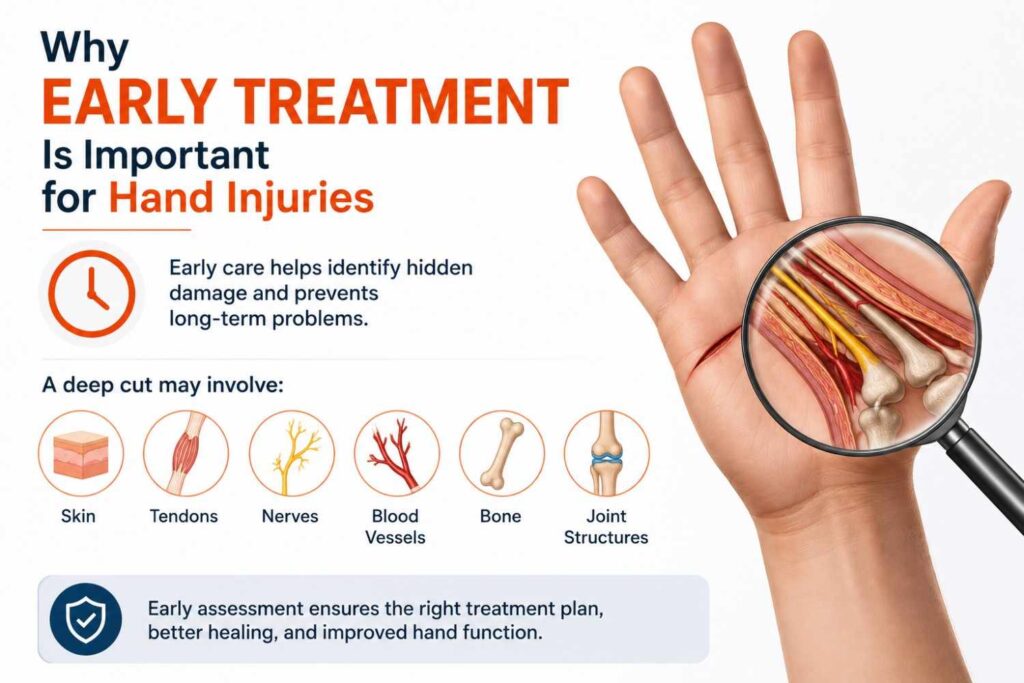
For example, a deep cut may involve:
- Skin
- Tendons
- Nerves
- Blood vessels
- Bone
- Joint structures
Treating only the visible wound may not address deeper damage.
Early assessment allows a healthcare professional to determine which structures are affected and develop an appropriate treatment plan.
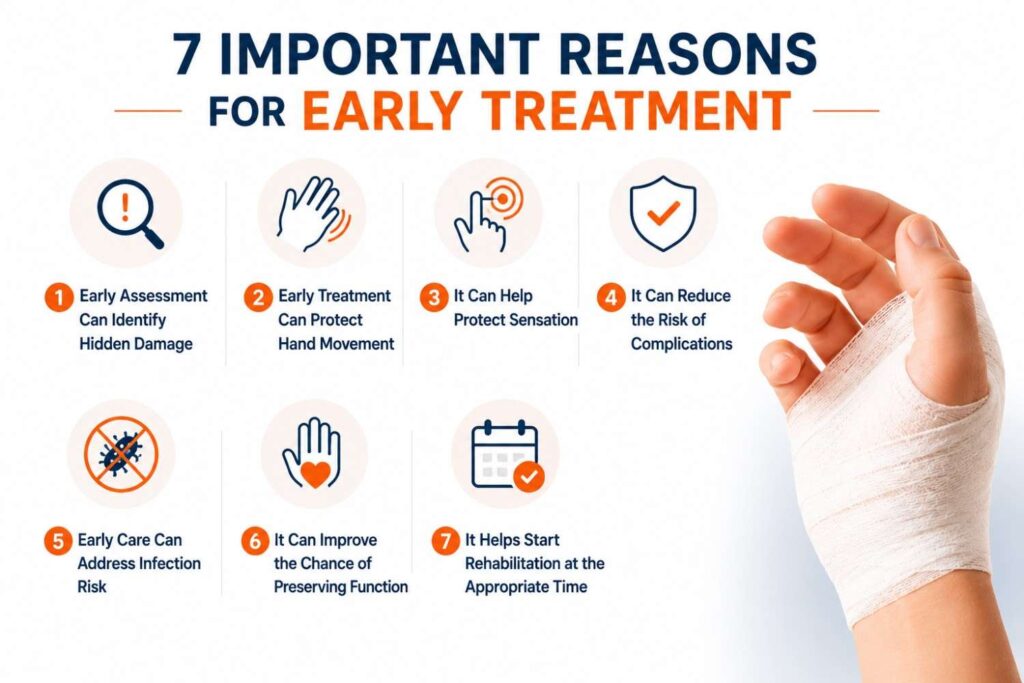
7 Important Reasons for Early Treatment
1. Early Assessment Can Identify Hidden Damage
One of the strongest reasons why early treatment is important for hand injuries is that some serious damage cannot be identified simply by looking at the skin.
A small opening in the skin can extend deeper into the hand.
A wound may potentially involve a tendon or nerve even when the external appearance does not seem severe.
Similarly, a fracture may not always be obvious without appropriate examination or imaging.
A clinical assessment can evaluate:
- Finger movement
- Joint stability
- Sensation
- Grip function
- Circulation
- Wound depth
- Bone alignment
Identifying the affected structures early helps prevent important injuries from being overlooked.
2. Early Treatment Can Protect Hand Movement
Normal hand movement depends on the coordinated function of muscles, tendons, joints, and nerves.
If an injury affects one of these structures, movement may become restricted.
For example, tendon damage can interfere with the ability to bend or straighten a finger.
Joint injuries can cause instability or stiffness.
Nerve injuries can affect the signals required for muscle movement.
Early assessment helps determine what has been damaged and whether protection, rehabilitation, or surgical treatment is necessary.
This is another important reason why early treatment is important for hand injuries.
3. It Can Help Protect Sensation
The nerves of the hand provide important information about touch, pressure, temperature, and pain.
A damaged nerve may cause:
- Numbness
- Tingling
- Burning sensations
- Reduced sensitivity
- Altered sensation
- Weakness
After a deep cut or traumatic injury, persistent numbness should not automatically be assumed to be temporary.
Early evaluation can help determine whether a nerve has been compressed, stretched, bruised, or significantly damaged.
Protecting useful sensation is particularly important because reduced sensation can affect how safely a person interacts with hot, sharp, or rough objects.
4. It Can Reduce the Risk of Complications
Untreated or inadequately treated hand injuries can sometimes lead to complications.
Depending on the type of injury, possible concerns may include:
- Infection
- Stiffness
- Poor wound healing
- Joint instability
- Persistent weakness
- Reduced sensation
- Scar-related restriction
- Incorrect bone healing
- Long-term functional limitations
Not every untreated injury will develop complications, but early assessment provides an opportunity to identify potential problems before they become more difficult to manage.
This explains why early treatment is important for hand injuries, even when symptoms initially appear manageable.
5. Early Care Can Address Infection Risk
Open wounds provide an opportunity for bacteria to enter the body.
The risk can be greater when a wound is:
- Deep
- Dirty
- Contaminated
- Caused by machinery
- Caused by an animal or human bite
- Associated with damaged tissue
- Associated with a foreign object
Proper wound assessment may involve cleaning, removal of foreign material, dressing, closure when appropriate, and monitoring.
Depending on the circumstances, a healthcare professional may also consider tetanus protection or antibiotics.
Hand infections require attention because infection can involve deeper structures such as joints, tendons, or bone.
6. It Can Improve the Chance of Preserving Function
The primary goal of hand injury treatment is not simply to close a wound.
The larger goal is to preserve or restore useful function.
This may include:
- Finger movement
- Thumb function
- Grip
- Pinch strength
- Sensation
- Coordination
- Joint stability
- Hand appearance
A delay in addressing a significant injury can sometimes make reconstruction or rehabilitation more complicated.
Early diagnosis allows the treatment team to consider the full functional picture rather than treating only the most visible symptom.
7. It Helps Start Rehabilitation at the Appropriate Time
- Hand rehabilitation requires careful timing.
- Some injuries need protection before movement begins.
- Others benefit from carefully controlled movement at an earlier stage.
- Starting exercises too aggressively can potentially stress a healing repair, while unnecessary immobilisation may contribute to stiffness.
- A specialist can determine when and how rehabilitation should begin.
- This is another practical reason why early treatment is important for hand injuries.
What Happens If Hand Injuries Are Ignored?
Not every minor hand injury requires specialist intervention.
However, significant injuries should not be ignored simply because the pain decreases.
Some structural injuries can remain after the initial discomfort improves.
For example, a person may continue to have:
- Difficulty bending a finger
- Difficulty straightening a finger
- Persistent numbness
- Reduced grip
- Finger deformity
- Joint instability
- Limited movement
If these symptoms continue, the underlying injury may require further assessment.
Early Treatment After a Hand Cut
A cut should be assessed based on more than its length.
Important questions include:
- Is the wound deep?
- Is there persistent bleeding?
- Can the affected finger move normally?
- Is sensation normal?
- Is the finger warm and adequately perfused?
- Is there visible foreign material?
- Was the object contaminated?
- Was the injury caused by a bite?
If movement or sensation has changed after a cut, medical assessment is particularly important.
The wound may require professional cleaning, closure, or further evaluation of deeper structures.
Early Treatment After a Crush Injury
Crush injuries deserve careful attention because several tissues can be damaged simultaneously.
A crush injury may affect:
- Bone
- Muscle
- Tendon
- Nerve
- Blood vessel
- Skin
- Soft tissue
Swelling can also increase after the initial accident.
For this reason, significant crush injuries should be evaluated promptly rather than judged only by the external appearance.
Early Treatment After a Fracture
A fracture may cause pain, swelling, bruising, deformity, or difficulty moving the hand.
However, symptoms alone cannot always determine the exact fracture pattern.
An examination and imaging may be required.
Depending on the fracture, treatment can include:
- Splinting
- Casting
- Reduction
- Follow-up imaging
- Surgical fixation
- Rehabilitation
The purpose of timely assessment is to determine the safest approach for maintaining alignment and function.
Early Treatment for Tendon Injuries
Tendon injuries are particularly important because tendons are responsible for transferring muscle force to bones.
A damaged tendon can make certain movements difficult or impossible.
A person may assume that pain is responsible for the reduced movement when the underlying issue is actually tendon damage.
A specialist examination can assess active movement and determine whether further investigation or repair is needed.
Early Treatment for Nerve Injuries
Nerve injuries require particular attention because sensation and muscle control may be affected.
Symptoms can include:
- Numbness
- Tingling
- Burning
- Weakness
- Reduced coordination
- Loss of protective sensation
Early evaluation helps determine whether the nerve is intact, compressed, bruised, stretched, or severely damaged.
The treatment approach depends on the type and severity of the injury.
Early Treatment and Microsurgery
Some complex hand injuries require highly precise repair.
Microsurgery can be used in selected cases involving very small nerves and blood vessels.
Depending on the injury, microsurgical procedures may include:
- Nerve repair
- Nerve grafting
- Blood vessel repair
- Tissue transfer
- Replantation
- Complex reconstruction
Not every hand injury requires microsurgery.
However, early specialist assessment can help determine whether advanced reconstruction is appropriate.
Benefits of Early Treatment for Hand Injuries
There are several potential benefits to seeking timely medical assessment.
- Better Understanding of the Injury
Early assessment can clarify what structures have been affected.
- Protection of Hand Function
Appropriate treatment can focus on preserving movement, sensation, strength, and coordination.
- Better Treatment Planning
Doctors can determine whether conservative treatment, rehabilitation, or surgery is appropriate.
- Reduced Risk of Avoidable Complications
Prompt wound care and appropriate management can help address certain risks.
- Earlier Rehabilitation Planning
A structured rehabilitation plan can be introduced at the appropriate stage.
- Improved Functional Recovery
When the injury is correctly diagnosed and managed, treatment can focus on restoring useful hand function.
When Should You Seek Immediate Medical Attention?
Certain signs should not be delayed.
Seek urgent medical assessment when a hand injury causes:
- Severe or uncontrolled bleeding
- Major deformity
- Exposed bone
- Complete loss of sensation
- Sudden inability to move a finger
- A pale, blue, or unusually cold finger
- A deep wound
- Significant crush injury
- Severe swelling
- An injury involving machinery
- A serious bite
- Severe pain following major trauma
The appropriate level of care depends on the injury and its severity.
Conclusion
Understanding why early treatment is important for hand injuries can help patients make informed decisions after an accident. A hand injury that appears minor from the outside can sometimes involve deeper structures such as tendons, nerves, joints, bones, or blood vessels.
Early assessment provides an opportunity to identify these problems and determine whether the injury needs wound care, splinting, observation, rehabilitation, or surgical treatment. It can also help address concerns such as infection, loss of movement, reduced sensation, joint instability, and functional limitations.
The goal of treatment is not simply to make the wound look better. It is to protect or restore useful hand function, including movement, strength, sensation, coordination, and the ability to perform everyday activities.
Patients in Thrissur who experience a significant hand injury should consider timely medical evaluation, particularly when there is numbness, weakness, deformity, loss of movement, deep wounds, severe swelling, or changes in finger circulation. Understanding why early treatment is important for hand injuries can encourage appropriate action and support a more informed path toward recovery.For additional information about breast augmentation procedures and implant safety, visit the American Society of Plastic Surgeons Breast Augmentation Resources.
FREQUENTLY ASKED QUESTIONS

Dr Vinu Roy
Plastic and Cosmetic SurgeonDr Vinu Roy is a plastic and cosmetic surgeon with expertise in cosmetic surgery, reconstructive surgery, microvascular surgery, hand surgery, trauma reconstruction, and brachial plexus procedures.
He focuses on enhancing both form and function with personalized surgical care, helping patients achieve their aesthetic and reconstructive goals with confidence.
Sushrutha Institute of Plastic, Reconstructive, and Aesthetic Surgery, Elite Mission Hospital, Koorkenchery, Thrissur

