
7 Key Stages in the Recovery Timeline After Hand Injury Surgery
The recovery timeline after hand injury surgery is an important concern for anyone who has undergone an operation following a serious hand injury. While some patients regain comfortable movement within a few weeks, others need several months of rehabilitation before strength, coordination, and sensation improve. In Thrissur, patients undergoing hand injury surgery may receive a recovery plan based on the specific structures repaired and their individual functional needs.
The hand is a highly complex part of the body. Bones, joints, tendons, ligaments, nerves, blood vessels, muscles, and skin must work together for normal function. Surgery may repair one structure or several structures at the same time.
Because every injury is different, there is no single recovery timeline after hand injury surgery that applies to everyone. A simple fracture repair may have a different rehabilitation schedule from tendon repair, nerve reconstruction, or complex soft-tissue reconstruction.
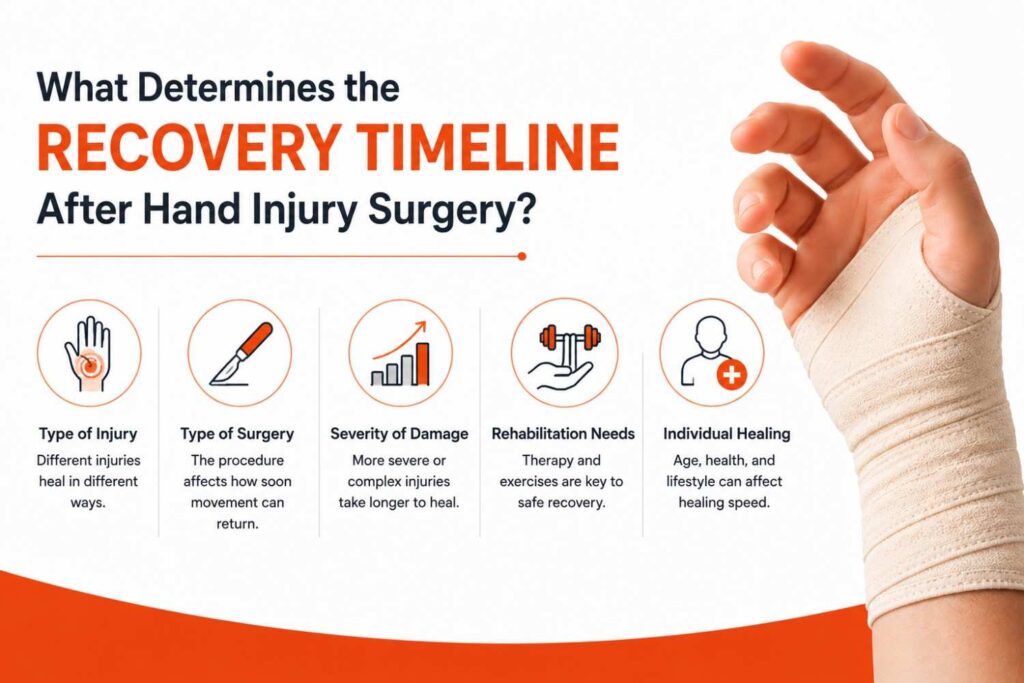
What Determines the Recovery Timeline After Hand Injury Surgery?
Several factors can influence the recovery timeline after hand injury surgery.
Type of Injury
The original injury has a major effect on recovery.
For example, treatment for a stable fracture may involve a different rehabilitation pathway from surgery for:
- Tendon damage
- Nerve injury
- Joint reconstruction
- Ligament injury
- Crush injury
- Open wound
- Blood vessel damage
- Soft-tissue loss
- Multiple-structure trauma
Type of Surgery
The procedure performed also affects how quickly movement and strength can be restored.
A small procedure may allow earlier movement, while complex reconstruction may require a longer period of protection.
Severity of Damage
A straightforward injury involving one structure may heal differently from an injury affecting several tissues.
Severe trauma may require multiple procedures and a longer rehabilitation period.
Rehabilitation Needs
Hand therapy is often an important part of recovery. The exercises and timing depend on the tissues that were repaired.
Individual Healing
Age, general health, nutrition, smoking status, circulation, and other factors can influence wound and tissue healing.
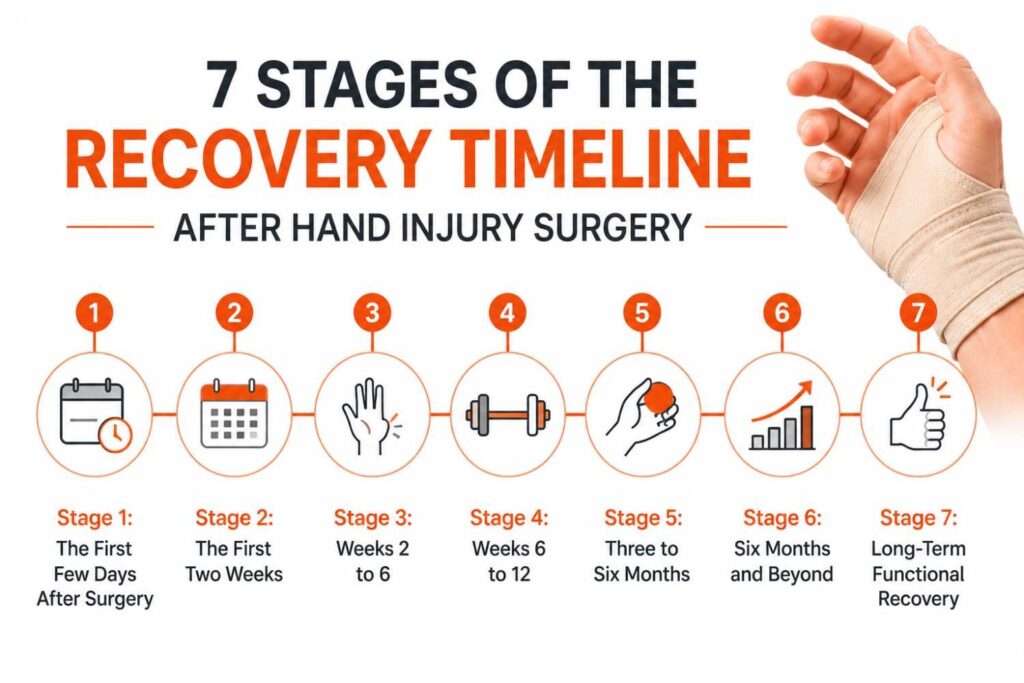
7 Stages of the Recovery Timeline After Hand Injury Surgery
The following stages provide a general framework. Your surgeon’s instructions should always take priority because rehabilitation must be adapted to the actual repair.
Stage 1: The First Few Days After Surgery
The first few days are mainly focused on protecting the surgical repair and controlling pain and swelling.
The hand may be placed in a dressing, splint, or protective support.
During this early stage, patients may experience:
- Swelling
- Bruising
- Mild to moderate pain
- Stiffness
- Reduced movement
- Temporary changes in sensation
Keeping the hand elevated as instructed may help reduce swelling.
Medication may also be prescribed for pain control.
Patients should avoid using the operated hand for activities that could place stress on the repair.
The exact restrictions depend on the operation. Some procedures require strict immobilisation, while others allow carefully controlled movement soon after surgery.
Stage 2: The First Two Weeks
The recovery timeline after hand injury surgery often includes close monitoring during the first couple of weeks.
Follow-up appointments may be used to check:
- The surgical wound
- Swelling
- Circulation
- Sensation
- Finger movement
- Splint or dressing
- Signs of infection
- Stability of the repair
The surgical team may change the dressing or adjust the protective support.
If stitches are present, their removal depends on the wound and the procedure.
During this period, patients should not assume that reduced pain means the hand is fully healed.
The tissues underneath the skin may still be vulnerable.
Why Protection Matters
A repaired tendon, nerve, ligament, or bone needs appropriate protection during healing.
Returning to normal activity too early can place unnecessary stress on healing tissues.
At the same time, prolonged immobilisation can contribute to stiffness in some situations.
This is why the rehabilitation schedule should be individualised rather than based on a general calendar.
Stage 3: Weeks 2 to 6
The next part of the recovery timeline after hand injury surgery often focuses on gradually restoring safe movement.
Depending on the procedure, a surgeon or hand therapist may introduce specific exercises.
These may focus on:
- Finger movement
- Wrist movement
- Joint flexibility
- Tendon glide
- Swelling control
- Scar management
- Gentle functional activities
The timing is different for each operation.
For example, some fracture repairs can allow controlled motion relatively early when the fixation is stable. AAOS notes that after surgical fracture treatment, motion exercises may begin relatively soon in some cases to help reduce stiffness, depending on the complexity and stability of the repair.
Tendon repairs, however, require particularly careful rehabilitation because excessive force can damage the repair.
Therefore, patients should never copy exercises from another person’s recovery plan.
Stage 4: Weeks 6 to 12
Between approximately six and twelve weeks, many patients begin moving from basic protection toward functional rehabilitation.
The exact progress depends on the injury.
At this stage, therapy may gradually address:
Range of Motion
The goal is to improve movement without placing excessive stress on healing tissues.
Strength
When the surgeon confirms that the repair is sufficiently healed, strengthening exercises may be introduced.
Coordination
Patients may practise controlled movements involving several fingers and the wrist.
Functional Activities
Therapy may gradually incorporate activities needed for:
- Writing
- Typing
- Dressing
- Cooking
- Holding objects
- Personal care
- Work-related movements
This stage can be particularly important because having movement does not necessarily mean the hand has regained normal strength.
Stage 5: Three to Six Months
The recovery timeline after hand injury surgery can extend well beyond the initial wound-healing period.
Between three and six months, many patients are working toward greater strength, endurance, coordination, and independence.
However, recovery varies considerably.
For some fractures, bone healing may require several months. AAOS notes that adult forearm bones, for example, can take around three to six months to fully heal, with more severe injuries potentially taking longer.
Hand injuries involving nerves may have a different recovery pattern.
Nerve tissue can take much longer to recover than skin or a surgical incision.
Therefore, a patient may have a well-healed wound while still experiencing:
- Numbness
- Tingling
- Reduced sensitivity
- Weakness
- Altered coordination
This does not necessarily mean that treatment has failed. Nerve recovery can be gradual and needs to be assessed over time.
Stage 6: Six Months and Beyond
Some complex hand injuries require rehabilitation for six months or longer.
At this stage, the focus may shift toward improving the remaining limitations and returning to higher-level activities.
Therapy may include:
- Progressive strengthening
- Grip training
- Fine motor exercises
- Sensory retraining
- Work-specific exercises
- Scar management
- Coordination activities
- Endurance training
Some patients may return to most normal activities, while others may continue to experience stiffness, weakness, altered sensation, or reduced movement.
The final outcome depends heavily on the original injury and the structures involved.
Stage 7: Long-Term Functional Recovery
The final stage of the recovery timeline after hand injury surgery is not necessarily a specific number of weeks or months.
Instead, it is the point at which the patient reaches the best functional level possible for their particular injury.
A person may be considered functionally recovered when they can safely perform the activities that matter to them, even if some minor symptoms remain.
For complex injuries, improvement can continue for a long time.
Some nerve procedures may have particularly extended recovery periods. AAOS notes that after certain nerve decompression procedures, final results may take 12 to 18 months in some patients.
This illustrates why patients should not judge the final result too early.
Recovery Timeline After Hand Injury Surgery for Different Procedures
The recovery pathway varies according to the type of surgery.
Fracture Surgery
- After fracture fixation, the hand may initially require a splint or brace.
- As healing progresses, controlled movement and therapy may be introduced.
- Strengthening and return to heavier activity usually depend on evidence that the bone and surrounding tissues are sufficiently healed.
Tendon Repair
- Tendon surgery requires carefully controlled rehabilitation.
- The repaired tendon needs protection while it heals, but appropriately timed movement may be important to reduce stiffness and improve tendon glide.
- Too much force too early can threaten the repair.
Nerve Repair
- Nerve recovery is often slower than skin or wound healing.
- Patients may notice gradual changes in sensation rather than immediate restoration.
- Depending on the injury, recovery may continue for many months.
Ligament Repair
- Ligament surgery may require an initial period of protection followed by gradual restoration of movement and strength.
- Returning to activities that place stress on the repaired joint should wait until the treating team confirms adequate healing.
Soft-Tissue Reconstruction
- Patients who undergo skin grafting or flap reconstruction may require careful wound monitoring and gradual rehabilitation.
- The recovery plan can involve both tissue healing and restoration of movement.
Complex Hand Trauma
- When bones, tendons, nerves, vessels, and soft tissues are damaged together, recovery may be considerably longer.
- Multiple procedures may sometimes be required.
- Rehabilitation can become an important long-term part of treatment.
How Can You Support a Better Recovery?
Patients can take several practical steps to support recovery.
Follow Your Surgeon’s Instructions
Do not change your splint, exercise programme, medication schedule, or activity restrictions without medical guidance.
Attend Follow-Up Appointments
Follow-up allows the medical team to monitor healing and adjust the treatment plan.
Complete Recommended Therapy
Consistent rehabilitation can be important for restoring movement and function.
Protect the Surgical Area
Avoid activities that place unexpected pressure on the hand.
Manage Swelling
Use elevation or other measures recommended by your healthcare team.
Maintain a Healthy Diet
Adequate nutrition provides the body with the nutrients required for tissue repair.
Avoid Smoking
Discuss smoking cessation with your healthcare provider if applicable.
Be Patient
Hand recovery is often gradual.
A small improvement in movement, strength, or sensation can be part of a longer recovery process.
Why Recovery Can Feel Slow
Many patients expect the hand to return to normal soon after the wound heals.
However, wound healing is only one part of recovery.
The deeper tissues may still be healing.
For example:
- Bone requires time to consolidate.
- Tendons need time to regain strength.
- Nerves can recover slowly.
- Muscles may weaken after reduced use.
- Joints may become stiff.
- Scar tissue may mature gradually.
Therefore, the recovery timeline after hand injury surgery should be viewed as a gradual process rather than a single recovery date.
Conclusion
The recovery timeline after hand injury surgery is influenced by the type of injury, surgical procedure, structures involved, healing capacity, and rehabilitation plan. Recovery usually progresses through several stages, beginning with wound protection and swelling control and gradually moving toward movement, strengthening, coordination, and functional activities.
A patient recovering from fracture surgery may follow a different pathway from someone who has undergone tendon repair, nerve reconstruction, ligament repair, or complex soft-tissue reconstruction. This is why comparing your recovery with another person’s experience may not provide an accurate picture.
Following medical instructions, attending follow-up appointments, completing recommended hand therapy, protecting the surgical repair, and gradually returning to activity can all support recovery.
For patients undergoing hand injury surgery in Thrissur, understanding the expected stages can make the rehabilitation process easier to manage. Most importantly, recovery should be guided by the specific injury and surgical repair rather than by a fixed number of days or weeks.For additional information about breast augmentation procedures and implant safety, visit the American Society of Plastic Surgeons Breast Augmentation Resources.
FREQUENTLY ASKED QUESTIONS

Dr Vinu Roy
Plastic and Cosmetic SurgeonDr Vinu Roy is a plastic and cosmetic surgeon with expertise in cosmetic surgery, reconstructive surgery, microvascular surgery, hand surgery, trauma reconstruction, and brachial plexus procedures.
He focuses on enhancing both form and function with personalized surgical care, helping patients achieve their aesthetic and reconstructive goals with confidence.
Sushrutha Institute of Plastic, Reconstructive, and Aesthetic Surgery, Elite Mission Hospital, Koorkenchery, Thrissur

