
10 Key Types: What Are the Different Types of Hand Injuries?
What are the different types of hand injuries? This is an important question because the hand contains many structures that work together, including bones, joints, tendons, ligaments, muscles, nerves, blood vessels, and soft tissues. An injury that looks small on the outside can sometimes affect deeper structures and interfere with movement, strength, sensation, or coordination.
Understanding what are the different types of hand injuries can help people recognise when an injury may need professional assessment. Hand injuries can happen because of road accidents, workplace incidents, sports, falls, sharp objects, crushing forces, burns, bites, or other unexpected events.
The right hand injury treatment depends on the type and severity of the injury. Some injuries may improve with rest, splinting, wound care, medication, and physiotherapy. Others may require fracture fixation, tendon repair, nerve repair, ligament reconstruction, microsurgery, or soft-tissue reconstruction.
What Are the Different Types of Hand Injuries?
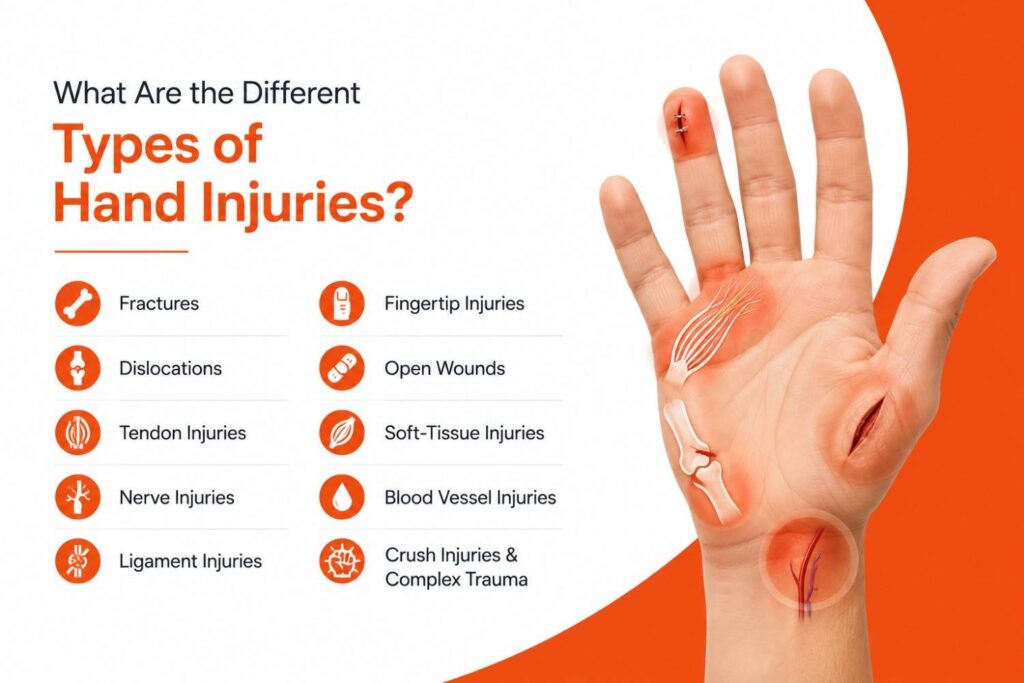
When discussing what are the different types of hand injuries, it is useful to classify them according to the structures involved. The major categories include:
- Hand and finger fractures
- Dislocations
- Tendon injuries
- Nerve injuries
- Ligament injuries
- Fingertip injuries
- Open wounds
- Soft-tissue injuries
- Blood vessel injuries
- Crush injuries and complex trauma
Each type can affect hand function differently. Some injuries involve only one structure, while severe trauma may damage several structures at the same time.
For example, a deep cut may involve the skin as well as an underlying tendon, nerve, or blood vessel. A crush injury may affect bones, muscles, nerves, tendons, vessels, and skin simultaneously.
Therefore, understanding what are the different types of hand injuries is not only about identifying the visible wound. A proper assessment considers the structures underneath the skin and how they are functioning.
Why Understanding What Are the Different Types of Hand Injuries Matters
The hand plays an important role in everyday life. Writing, typing, cooking, driving, dressing, bathing, using tools, holding objects, and operating mobile devices all require coordinated hand movement.
The hand also provides important sensory information. Nerves help a person recognise pressure, temperature, texture, and pain. If nerves are damaged, protective sensation may be reduced.
Knowing what are the different types of hand injuries can help people understand why symptoms such as numbness, weakness, deformity, or loss of movement should not always be ignored.
A suitable evaluation can help determine:
- Which structures are injured
- How severe the injury is
- Whether circulation is affected
- Whether movement is restricted
- Whether sensation is reduced
- Whether infection is present
- Whether surgery may be necessary
- What type of rehabilitation may be required
Common Causes of Different Hand Injuries
The causes of what are the different types of hand injuries vary widely. A hand injury can occur during routine activities or high-impact trauma.
- Road Traffic Accidents
Road traffic accidents can cause fractures, dislocations, deep wounds, crush injuries, tendon damage, nerve injuries, and soft-tissue loss.
Motorcycle riders may injure their hands during a fall, impact, or attempt to protect themselves.
- Workplace Injuries
Workplaces involving machinery, sharp tools, heavy equipment, construction materials, or industrial processes may expose the hands to injury.
Common workplace injuries include:
- Deep cuts
- Crush injuries
- Finger fractures
- Tendon injuries
- Burns
- Partial tissue loss
- Foreign-body injuries
- Falls
Falling onto an outstretched hand can place significant force on the fingers, wrist, joints, and ligaments. Fractures, sprains, and dislocations can occur.
- Sports Injuries
Sports such as cricket, football, volleyball, basketball, badminton, martial arts, and weight training may result in different types of hand injuries.
Common examples include:
- Jammed fingers
- Ligament injuries
- Tendon injuries
- Wrist sprains
- Fractures
- Dislocations
- Cuts and Lacerations
Sharp objects such as glass, knives, metal sheets, or machinery can cause open wounds. A deep cut may damage a tendon, nerve, artery, joint, or other deeper structure.
- Crush Injuries
Crush injuries occur when the hand becomes trapped between objects, inside machinery, beneath heavy materials, or during a vehicle accident.
These are among the more complex examples when considering what are the different types of hand injuries because several structures may be damaged simultaneously.
- Burns
Thermal, electrical, and chemical burns can damage skin and deeper tissues. Scarring during healing can sometimes restrict movement of the fingers or wrist.
- Bites and Infections
Animal and human bites can introduce bacteria into the tissues. If treatment is delayed, infection may extend into deeper structures such as joints, tendon coverings, or bone.
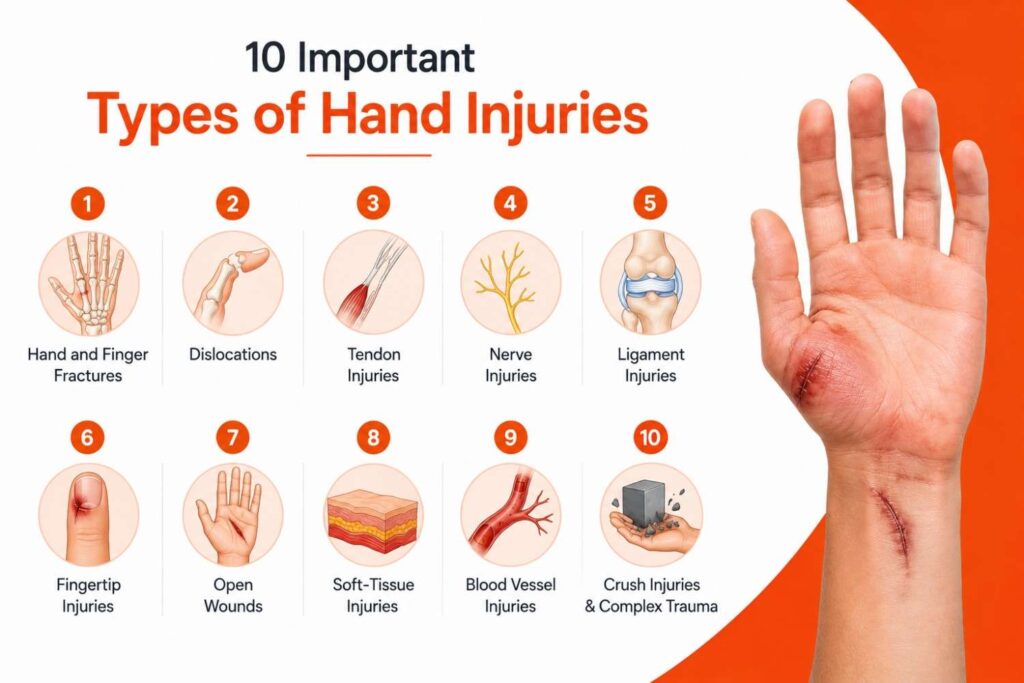
10 Important Types of Hand Injuries
Understanding what are the different types of hand injuries becomes easier when each category is considered separately.
1. Hand and Finger Fractures
A fracture means that one or more bones have broken. Fractures can vary in complexity and may be:
- Stable
- Displaced
- Rotated
- Open
- Comminuted
- Involving a joint
Stable fractures may sometimes be managed with splinting or casting. Unstable fractures may need fixation to restore alignment and stability.
2. Dislocations
A dislocation occurs when the bones forming a joint move out of their normal position.
A dislocated finger or joint may appear deformed. Movement can become painful or difficult, and the surrounding ligaments may also be injured.
3. Tendon Injuries
Tendons connect muscles to bones and allow the fingers and wrist to bend and straighten.
A tendon may be cut, stretched, ruptured, or pulled away from its attachment. Tendon injuries can significantly affect movement.
A person may have difficulty bending or straightening a finger even when the skin wound appears relatively small.
4. Nerve Injuries
Nerves provide sensation and help control movement. Nerve injuries may result in:
- Numbness
- Tingling
- Burning sensations
- Weakness
- Reduced coordination
- Reduced protective sensation
Some nerve injuries may recover with observation and appropriate rehabilitation. Severely damaged or completely divided nerves may require surgical repair.
5. Ligament Injuries
Ligaments connect bones and provide joint stability.
When a ligament is stretched or torn, the affected joint may become painful, weak, or unstable. Severe ligament injuries may require repair or reconstruction.
6. Fingertip Injuries
Fingertip injuries can involve the nail, skin, bone, sensation, and soft-tissue padding.
Treatment depends on the amount of tissue involved and whether bone or other deeper structures are exposed.
7. Open Wounds
Open wounds can occur because of cuts, punctures, accidents, or other trauma. Dirt, glass, metal, and other foreign materials may sometimes enter the wound.
Proper cleaning and examination are important, especially when the wound is deep or contaminated.
8. Soft-Tissue Injuries
Soft-tissue injuries can involve the skin, fat, fascia, muscles, and connective tissues.
More severe injuries may result in tissue loss or exposure of deeper structures and may require reconstructive procedures.
9. Blood Vessel Injuries
Blood vessels supply oxygen and nutrients to the hand and fingers. Damage to an artery can reduce blood flow.
A finger that becomes pale, blue, cold, or poorly perfused after an injury requires urgent medical assessment.
10. Crush Injuries and Complex Trauma
Crush injuries can affect several structures at once. Bones, tendons, nerves, muscles, blood vessels, and skin may all be involved.
These injuries can require a coordinated approach involving wound care, fracture management, reconstruction, microsurgery, and rehabilitation.
Symptoms of Hand Injuries
When considering what are the different types of hand injuries, symptoms can provide important clues, although symptoms alone cannot always identify the exact structure involved.
Possible symptoms include:
- Severe or persistent pain
- Swelling
- Bruising
- Visible deformity
- Bleeding
- Reduced movement
- Inability to bend a finger
- Inability to straighten a finger
- Numbness
- Tingling
- Burning sensations
- Reduced grip strength
- Joint instability
- Pale or blue skin
- A cold finger
- Exposed bone or tendon
- Increasing redness
- Pus or discharge
- Fever
Loss of movement or sensation can sometimes indicate deeper tendon or nerve damage even when pain is not severe.
When Should a Hand Injury Be Medically Evaluated?
Not every minor injury requires the same level of care. However, prompt assessment is important when there is significant pain, deformity, bleeding, loss of movement, numbness, or a deep wound.
Medical attention may be particularly important when:
- A finger looks crooked
- A finger cannot be moved normally
- Sensation is reduced
- Bleeding continues
- Bone or tendon is visible
- The wound is deep or contaminated
- A joint appears unstable
- A finger becomes pale, blue, or cold
- There is increasing swelling
- There are signs of infection
- The injury resulted from a bite
- Pain continues despite rest
Understanding what are the different types of hand injuries can help people recognise that an apparently small wound may sometimes involve important underlying structures.
Tips for Protecting the Hands
Although not every accident can be prevented, practical precautions may reduce the risk of injury.
- Use suitable protective equipment at work.
- Follow machinery safety instructions.
- Keep sharp tools handled and stored carefully.
- Use appropriate sports protection.
- Avoid placing hands near moving machinery.
- Keep children away from dangerous equipment.
- Take care when handling hot materials.
- Seek assessment for deep or contaminated wounds.
- Do not ignore persistent numbness or weakness.
- Follow rehabilitation instructions after treatment.
Conclusion
Knowing what are the different types of hand injuries helps explain why hand trauma should be assessed according to the structures involved rather than the appearance of the wound alone. Fractures, dislocations, tendon injuries, nerve injuries, ligament injuries, fingertip injuries, open wounds, soft-tissue injuries, blood vessel injuries, and crush injuries can all affect hand function in different ways.
Treatment may range from rest, splinting, medication, and wound care to fracture fixation, tendon repair, nerve reconstruction, ligament repair, microsurgery, and soft-tissue reconstruction. Rehabilitation is also an important part of restoring movement, strength, coordination, and sensation.
Anyone experiencing significant hand trauma should seek appropriate medical assessment, particularly when movement, sensation, circulation, or skin integrity is affected. For patients seeking specialist evaluation, timely care can support better long-term hand function. For additional information about breast augmentation procedures and implant safety, visit the American Society of Plastic Surgeons Breast Augmentation Resources.
FREQUENTLY ASKED QUESTIONS

Dr Vinu Roy
Plastic and Cosmetic SurgeonDr Vinu Roy is a plastic and cosmetic surgeon with expertise in cosmetic surgery, reconstructive surgery, microvascular surgery, hand surgery, trauma reconstruction, and brachial plexus procedures.
He focuses on enhancing both form and function with personalized surgical care, helping patients achieve their aesthetic and reconstructive goals with confidence.
Sushrutha Institute of Plastic, Reconstructive, and Aesthetic Surgery, Elite Mission Hospital, Koorkenchery, Thrissur

