
Why Is Early Treatment Important? 10 Essential Reasons
A hand injury can affect movement, grip, sensation, coordination, strength, and the ability to complete normal daily activities. Understanding why is early treatment important helps patients recognise that even a small cut, fracture, crush injury, or painful finger may involve deeper structures. People living in Kerala should seek timely assessment when an injury causes persistent swelling, numbness, weakness, deformity, bleeding, or restricted movement.
The hand contains bones, joints, tendons, ligaments, nerves, blood vessels, muscles, and soft tissues. These structures work together in a very limited space. When treatment is delayed, swelling, infection, scar formation, stiffness, and abnormal healing may make recovery more difficult.
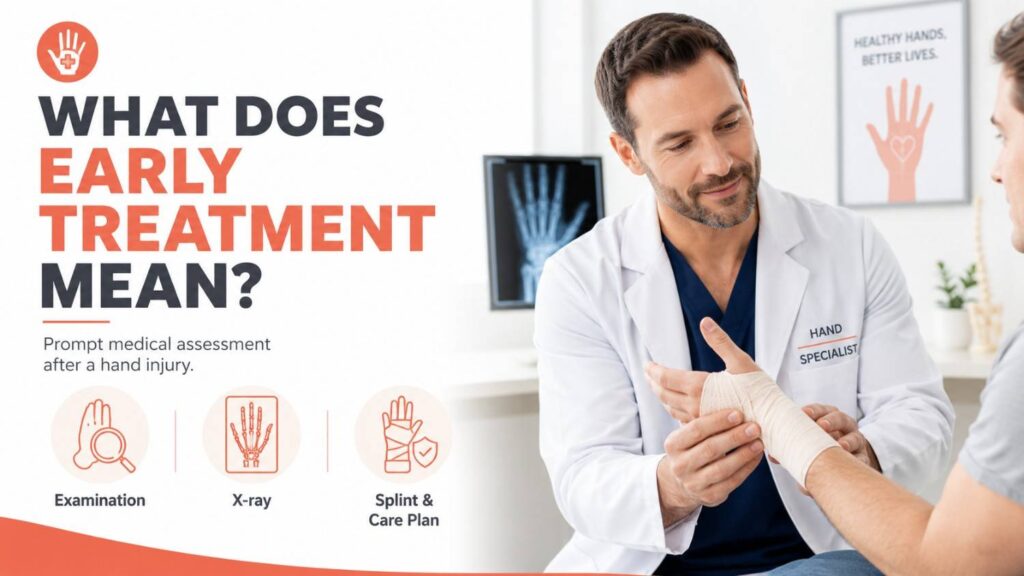
What Does Early Treatment Mean?
Early treatment means receiving an appropriate medical assessment soon after an injury or soon after concerning symptoms appear.
It does not mean that every patient must undergo surgery immediately. Early treatment may involve:
- Examining the injured hand
- Checking movement and sensation
- Assessing blood circulation
- Cleaning and dressing a wound
- Taking an X-ray
- Applying a splint or cast
- Prescribing medication
- Providing tetanus protection
- Planning physiotherapy
- Referring the patient for surgery when necessary
Understanding why is early treatment important begins with understanding the difference between early assessment and unnecessary intervention. A prompt examination helps determine whether the injury is minor, stable, serious, or time-sensitive.
Why Is Early Treatment Important?
The answer to why is early treatment important is that hand injuries can worsen when damaged structures are left untreated.
Prompt care can help:
- Identify fractures
- Detect tendon damage
- Assess nerve function
- Protect blood circulation
- Reduce infection risk
- Stabilise injured joints
- Prevent abnormal bone healing
- Reduce stiffness
- Start rehabilitation at the correct time
- Preserve useful hand function
A hand injury may not always look serious. Some tendon and nerve injuries cause little visible damage but can significantly affect movement and sensation.
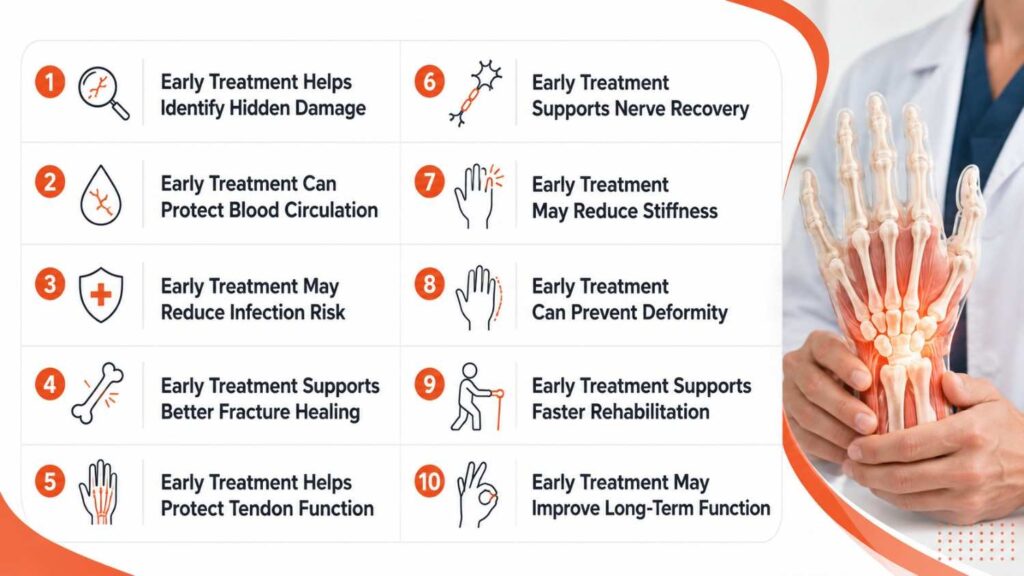
1. Early Treatment Helps Identify Hidden Damage
One of the main reasons why is early treatment important is that deeper damage may not be visible from the outside.
A small cut may involve:
- A flexor tendon
- An extensor tendon
- A sensory nerve
- A motor nerve
- A blood vessel
- A joint covering
- Bone
Similarly, a swollen finger after a fall may have a fracture, ligament tear, or dislocation rather than a simple sprain.
During an early examination, the hand surgeon may test:
- Finger movement
- Tendon function
- Joint stability
- Grip strength
- Sensation
- Blood flow
- Bone alignment
Early identification helps create a treatment plan before swelling, scar tissue, or stiffness makes the injury more difficult to assess.
2. Early Treatment Can Protect Blood Circulation
The fingers need a steady blood supply. Deep cuts, crushing, fractures, and dislocations may damage blood vessels.
Signs of reduced circulation include:
- A pale finger
- Blue or dark skin
- Unusual coldness
- Severe pain
- Numbness
- Slow colour return after pressure
- Persistent bleeding
Protecting circulation is a major reason why is early treatment important.
If blood flow is severely reduced, muscles, nerves, skin, and soft tissues may begin to suffer damage. Some blood-vessel injuries require urgent repair using microsurgical techniques.
A patient should not wait for the colour to improve on its own when a finger becomes cold, pale, blue, or numb after trauma.
3. Early Treatment May Reduce Infection Risk
Open wounds, bites, punctures, burns, and contaminated cuts can introduce bacteria into the hand.
The hand contains tendon coverings, joints, and small tissue spaces where infection can spread quickly.
Possible warning signs include:
- Increasing redness
- Warmth
- Swelling
- Pus
- Fever
- Severe tenderness
- Pain during finger movement
- Red lines extending from the wound
Reducing infection risk helps explain why is early treatment important after an open injury.
Early care may include:
- Thorough wound cleaning
- Removal of foreign material
- Removal of damaged tissue
- Antibiotics
- Tetanus protection
- Wound drainage
- Surgical cleaning when required
Delaying treatment may allow an infection to reach tendons, joints, or bone. Deep infections can require longer treatment and may affect movement.
4. Early Treatment Supports Better Fracture Healing
Fractures need proper alignment and stability to heal well.
A broken finger may look only slightly bent, but even a small rotational deformity can cause one finger to cross over another when the hand closes.
This is another important reason why is early treatment important.
Early fracture care may involve:
- X-rays
- Splinting
- Casting
- Buddy taping
- Bone realignment
- Surgical fixation
- Follow-up imaging
When a fracture heals in the wrong position, the patient may experience:
- Reduced grip strength
- Finger overlap
- Joint stiffness
- Pain
- Visible deformity
- Difficulty holding objects
Correcting an old, poorly healed fracture can be more complicated than treating it soon after the injury.
5. Early Treatment Helps Protect Tendon Function
Tendons connect muscles to bones and allow the fingers to bend and straighten.
A tendon may be cut, stretched, crushed, or pulled away from its attachment.
Possible signs include:
- Inability to bend a finger
- Inability to straighten a finger
- Weak movement
- A finger resting abnormally
- Sudden movement loss after a cut
- Pain along the tendon
Protecting movement is a key reason why is early treatment important.
A completely divided tendon generally requires repair. If treatment is delayed, the tendon ends may move apart, scar tissue may form, and the surrounding joints may become stiff.
Delayed tendon reconstruction can be more complex and may require additional procedures.
6. Early Treatment Supports Nerve Recovery
Nerves provide sensation and control several muscles in the hand.
Nerve injuries may cause:
- Numbness
- Tingling
- Burning pain
- Electric-shock sensations
- Weakness
- Poor coordination
- Loss of temperature awareness
- Difficulty holding small objects
Supporting nerve recovery is another reason why is early treatment important.
A mildly bruised nerve may recover with observation and rehabilitation. A completely divided nerve may require surgical repair, nerve grafting, or another reconstructive procedure.
Nerve recovery is gradual. Earlier evaluation helps determine whether the nerve is compressed, stretched, partly damaged, or completely divided.
Patients with numb areas must also protect the skin from burns, sharp objects, and repeated pressure.
7. Early Treatment May Reduce Stiffness
The small joints of the hand can become stiff quickly after injury.
Swelling, pain, prolonged immobilisation, scar tissue, tendon adhesions, and fear of movement can all reduce flexibility.
Preventing stiffness helps explain why is early treatment important.
Early care allows the treatment team to determine:
- Which joints need protection
- How long a splint should be used
- When movement can begin
- Which exercises are safe
- Whether hand therapy is needed
Movement should not begin too early after every injury. Repaired tendons, fractures, and ligaments require protection.
However, unnecessary immobilisation may make recovery more difficult. The correct balance depends on the diagnosis.
8. Early Treatment Can Prevent Deformity
Untreated fractures, dislocations, ligament injuries, and tendon damage may change the position of the fingers or joints.
Possible deformities include:
- Crooked fingers
- Rotational overlap
- Drooping fingertips
- Inability to straighten a joint
- Joint instability
- Shortened fingers
- Abnormal wrist position
Preventing deformity is a practical reason why is early treatment important.
Early alignment and stabilisation can help maintain normal anatomy while the tissues heal.
Some deformities can be corrected later, but delayed reconstruction may be more difficult and may not fully restore normal movement.
9. Early Treatment Supports Faster Rehabilitation
Rehabilitation helps restore movement, strength, sensation, coordination, and daily hand use.
Early assessment allows rehabilitation to begin at the correct stage.
The programme may include:
- Swelling control
- Range-of-motion exercises
- Tendon-gliding exercises
- Scar management
- Strengthening
- Sensory retraining
- Custom splinting
- Functional task training
Supporting structured rehabilitation is another answer to why is early treatment important.
Patients who receive delayed care may begin therapy after stiffness, weakness, and scar adhesions have already developed.
Recovery may then require more intensive treatment and a longer rehabilitation period.
10. Early Treatment May Improve Long-Term Function
The final goal of treatment is not simply wound closure or pain reduction. The goal is useful hand function.
Long-term hand function includes:
- Bending and straightening the fingers
- Gripping objects
- Pinching small items
- Feeling temperature and texture
- Performing personal care
- Returning to work
- Participating in hobbies
- Using tools safely
Protecting long-term function is perhaps the clearest explanation of why is early treatment important.
Early diagnosis, appropriate stabilisation, timely surgery when needed, and planned rehabilitation may improve the chance of a better functional outcome.
Complete recovery cannot be guaranteed because results depend on the severity of the injury and the structures involved.
Signs That Need Immediate Assessment
Some symptoms require urgent medical evaluation.
Seek immediate care when an injury causes:
- Uncontrolled bleeding
- Partial or complete amputation
- Exposed bone
- A pale, cold, or blue finger
- Complete loss of sensation
- Inability to move a finger
- Severe crush damage
- Rapidly increasing swelling
- Chemical or electrical burns
- Deep contaminated wounds
- Severe infection symptoms
- Visible deformity
These signs demonstrate why is early treatment important in emergency situations.
Do not attempt to straighten a badly deformed finger, remove deeply embedded objects, or push exposed tissue back into a wound.
What Can Happen If Treatment Is Delayed?
Delayed treatment does not always result in complications, but it may increase the risk of:
- Infection
- Abnormal fracture healing
- Persistent numbness
- Weak grip
- Tendon adhesions
- Joint stiffness
- Chronic pain
- Poor circulation
- Muscle weakness
- Visible deformity
- Reduced coordination
- Permanent functional limitation
Understanding these risks is central to understanding why is early treatment important.
The effects of delay depend on the injury. A mild sprain may still recover well, while an untreated artery, tendon, nerve, or open fracture may become more difficult to manage.
Conclusion
Understanding why is early treatment important can help patients recognise when a hand injury requires more than home care. Early assessment can identify hidden fractures, tendon injuries, nerve damage, reduced circulation, infection, or joint instability before these problems become more difficult to manage.
Prompt treatment may include wound care, splinting, medication, fracture stabilisation, surgery, or rehabilitation. The right approach depends on the exact structures involved.
Patients from Thrissur and other parts of Kerala can visit the main Hand Injury Treatment in Thrissur pillar page for further information. Ultimately, why is early treatment important comes down to protecting movement, sensation, circulation, strength, independence, and long-term hand function. For additional information about breast augmentation procedures and implant safety, visit the American Society of Plastic Surgeons Breast Augmentation Resources.
FREQUENTLY ASKED QUESTIONS

Dr Vinu Roy
Plastic and Cosmetic SurgeonDr Vinu Roy is a plastic and cosmetic surgeon with expertise in cosmetic surgery, reconstructive surgery, microvascular surgery, hand surgery, trauma reconstruction, and brachial plexus procedures.
He focuses on enhancing both form and function with personalized surgical care, helping patients achieve their aesthetic and reconstructive goals with confidence.
Sushrutha Institute of Plastic, Reconstructive, and Aesthetic Surgery, Elite Mission Hospital, Koorkenchery, Thrissur

