
Who Needs Hand Injury Treatment? 10 Essential Warning Signs!
A hand injury can make simple activities such as writing, cooking, typing, dressing, driving, and holding objects difficult. Understanding who needs hand injury treatment is important because some injuries that appear minor may damage deeper bones, tendons, nerves, ligaments, joints, or blood vessels. People living in Kerala should seek timely medical evaluation when an injured hand develops persistent pain, numbness, weakness, deformity, swelling, or restricted movement.
Not every hand injury requires surgery. Some conditions improve with rest, medication, splinting, wound care, and physiotherapy. However, severe fractures, deep cuts, tendon injuries, nerve damage, crush injuries, and circulation problems may need specialist or surgical management.
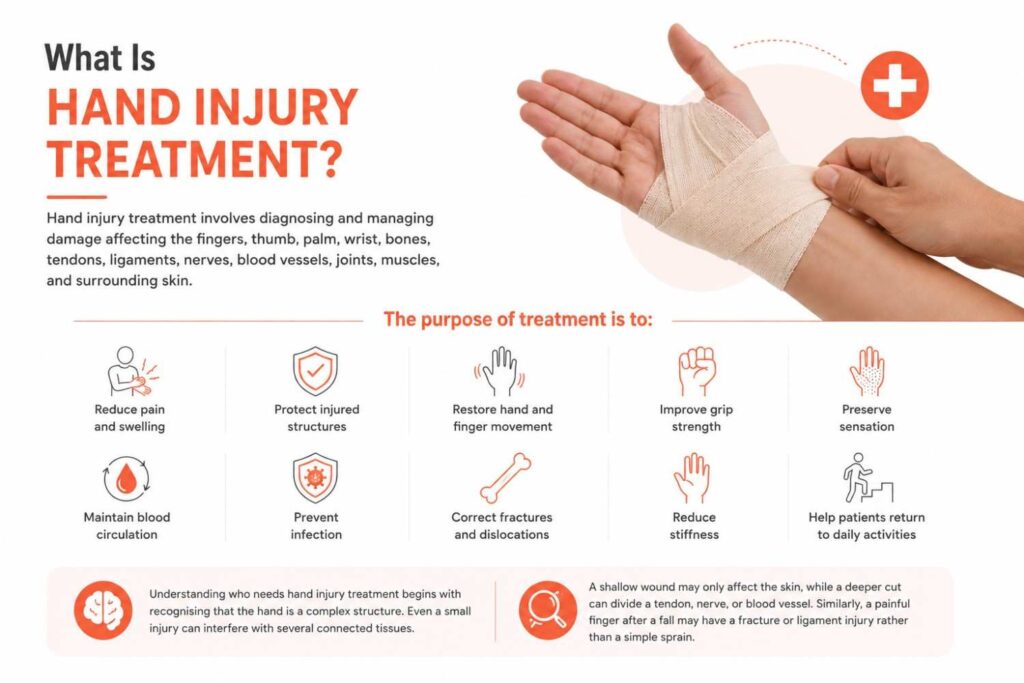
What Is Hand Injury Treatment?
Hand injury treatment involves diagnosing and managing damage affecting the fingers, thumb, palm, wrist, bones, tendons, ligaments, nerves, blood vessels, joints, muscles, and surrounding skin.
The purpose of treatment is to:
- Reduce pain and swelling
- Protect injured structures
- Restore hand and finger movement
- Improve grip strength
- Preserve sensation
- Maintain blood circulation
- Prevent infection
- Correct fractures and dislocations
- Reduce stiffness
- Help patients return to daily activities
Understanding who needs hand injury treatment begins with recognising that the hand is a complex structure. Even a small injury can interfere with several connected tissues.
A shallow wound may only affect the skin, while a deeper cut can divide a tendon, nerve, or blood vessel. Similarly, a painful finger after a fall may have a fracture or ligament injury rather than a simple sprain.
Who Needs Hand Injury Treatment?
Anyone experiencing continued pain, swelling, numbness, weakness, deformity, loss of movement, or a deep wound after an accident may need hand injury treatment.
Treatment may be necessary for people who have:
- Hand or finger fractures
- Deep cuts
- Tendon damage
- Nerve injuries
- Crush injuries
- Joint dislocations
- Ligament tears
- Burns
- Fingertip injuries
- Nail-bed injuries
- Animal or human bites
- Soft-tissue loss
- Blood vessel damage
- Infections
- Old injuries causing functional problems
The answer to who needs hand injury treatment depends on the structures involved and how the injury affects everyday hand function.
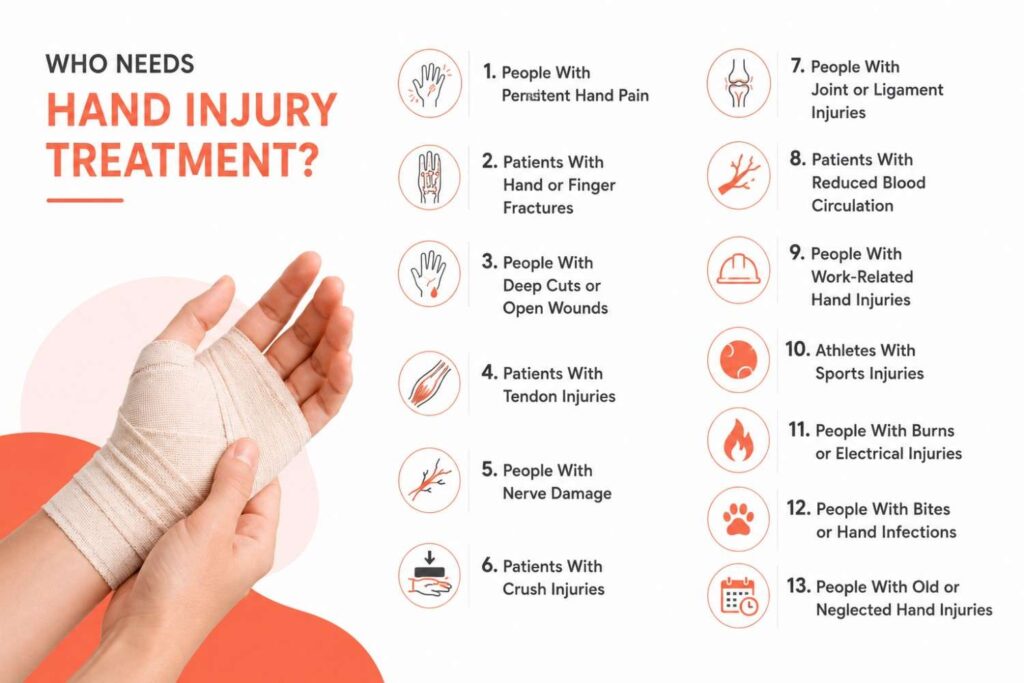
1. People With Persistent Hand Pain
Pain is common immediately after an injury. However, pain that remains severe, continues to increase, or does not improve with rest should be evaluated.
Persistent pain may indicate:
- An undiagnosed fracture
- Joint damage
- Ligament injury
- Tendon damage
- Nerve compression
- Infection
- Retained foreign material
- Abnormal bone alignment
People asking who needs hand injury treatment should not judge the injury only by its appearance. Significant internal damage may be present without a large wound or visible deformity.
Medical evaluation is especially important when pain prevents the person from gripping objects, moving a finger, sleeping comfortably, or performing routine work.
2. Patients With Hand or Finger Fractures
A fracture is a break in one or more bones of the hand, fingers, thumb, or wrist. Fractures commonly occur after falls, road accidents, sports injuries, direct impact, or crush accidents.
Possible fracture symptoms include:
- Immediate pain
- Swelling
- Bruising
- Tenderness
- Visible deformity
- Shortened or rotated finger
- Difficulty moving the hand
- Pain while gripping
- Abnormal finger position
Anyone with these symptoms may fall within the group of who needs hand injury treatment.
Stable fractures may be treated using a splint, cast, or buddy taping. Surgery may be considered when the fracture is displaced, unstable, rotated, open, or extends into a joint.
Early alignment is important because a poorly healed fracture can affect grip strength, finger movement, and hand coordination.
3. People With Deep Cuts or Open Wounds
Deep cuts caused by knives, glass, metal, machinery, or sharp tools require careful examination.
A cut may damage:
- Flexor tendons
- Extensor tendons
- Sensory nerves
- Motor nerves
- Arteries
- Muscles
- Joint coverings
- Bone
People with persistent bleeding, reduced movement, numbness, or exposed tissue clearly belong among those who need hand injury treatment.
A wound should also be evaluated when it is contaminated with soil, metal, glass, grease, or chemicals. Cleaning the visible surface may not remove material trapped deeper inside.
Open wounds may require irrigation, stitches, tetanus protection, antibiotics, removal of damaged tissue, or surgical repair.
4. Patients With Tendon Injuries
Tendons connect muscles to bones and allow the fingers and wrist to move. A tendon can be cut, stretched, crushed, or pulled away from its attachment.
Signs of a possible tendon injury include:
- Inability to bend a finger
- Inability to straighten a finger
- Weak finger movement
- Pain during movement
- A finger resting in an unusual position
- Movement that suddenly stopped after a cut
- Reduced grip or pinch strength
When considering who needs hand injury treatment, any person who cannot actively bend or straighten a finger after an injury should receive medical assessment.
Some partial tendon injuries still allow limited movement. This can make the condition easy to overlook. Continuing to use the injured finger may worsen tendon damage.
Complete tendon injuries frequently require repair followed by a protected rehabilitation programme.
5. People With Nerve Damage
Nerves provide sensation and control several hand muscles. They can be damaged by cuts, crushing, stretching, compression, fractures, or dislocations.
Possible symptoms include:
- Numbness
- Tingling
- Burning sensations
- Electric-shock-like pain
- Reduced touch sensation
- Weakness
- Poor finger coordination
- Difficulty holding small objects
- Inability to recognise temperature
People experiencing these symptoms after trauma are an important group when answering who needs hand injury treatment.
Mild nerve injuries may recover with observation and therapy. A divided or severely damaged nerve may need microsurgical repair, nerve grafting, decompression, or another reconstructive procedure.
Nerve recovery is gradual. Early diagnosis can help protect muscles and reduce the risk of permanent sensory loss.
6. Patients With Crush Injuries
Crush injuries occur when the hand becomes trapped under a heavy object, inside a machine, between vehicle parts, or in a closing door.
These injuries can simultaneously damage:
- Skin
- Muscles
- Bones
- Joints
- Tendons
- Nerves
- Blood vessels
- Fingernails
Crush injuries may initially look less severe than they are. Swelling and tissue damage can continue developing after the accident.
Patients with crush injuries are among those who need hand injury treatment because several structures may require treatment at the same time.
Management may include wound cleaning, fracture fixation, tendon repair, nerve repair, blood vessel reconstruction, soft-tissue coverage, and rehabilitation.
7. People With Joint or Ligament Injuries
Ligaments connect bones and stabilise joints. They may be stretched or torn during sports, falls, sudden twisting, or forceful impact.
Symptoms include:
- Joint pain
- Swelling
- Bruising
- Instability
- Clicking
- Restricted movement
- Weak grip
- A joint that appears out of position
A dislocated finger should not be ignored after it has been put back into place. Associated fractures, tendon damage, or ligament tears may still be present.
People wondering who needs hand injury treatment should consider specialist evaluation when a joint remains unstable, swollen, painful, or difficult to move.
Some ligament injuries improve with splinting and therapy. Complete tears or unstable joints may require repair or reconstruction.
8. Patients With Reduced Blood Circulation
Blood vessels carry oxygen to the fingers and tissues. Injury to an artery can reduce or completely stop circulation.
Warning signs include:
- A pale finger
- Blue or dark skin
- Unusual coldness
- Severe pain
- Loss of sensation
- Slow colour return after pressure
- Weak or absent pulse
- Bleeding that does not stop
People with circulation changes are among those who need hand injury treatment urgently.
Blood vessel repair may require microsurgery. Treatment should not be delayed because prolonged loss of circulation can damage nerves, muscles, skin, and other tissues.
9. People With Work-Related Hand Injuries
Workers in construction, manufacturing, agriculture, automotive repair, food preparation, metalwork, and other manual occupations may have an increased risk of hand trauma.
Common workplace injuries include:
- Machine-related crush injuries
- Tool-related cuts
- Chemical burns
- Thermal burns
- Fractures
- Tendon injuries
- Foreign-body wounds
- Finger amputations
Workers who rely heavily on their hands may need structured treatment and rehabilitation before returning to demanding activities.
The question who needs hand injury treatment also includes workers whose injury appears minor but prevents safe tool use, lifting, gripping, typing, or operating equipment.
A return-to-work plan may involve temporary restrictions, modified duties, protective equipment, and gradual strengthening.
10. Athletes With Sports Injuries
Sports can cause fractures, dislocations, ligament tears, jammed fingers, tendon injuries, and wrist sprains.
Players may need medical evaluation when they experience:
- Persistent swelling
- Joint instability
- Reduced grip strength
- Difficulty catching or throwing
- Finger deformity
- Pain during movement
- Repeated injury to the same joint
Athletes sometimes continue playing because they assume the injury is a simple sprain. However, untreated joint or tendon damage can reduce future performance.
Athletes are therefore another group within who needs hand injury treatment, particularly when symptoms remain after initial rest and basic care.
11. People With Burns or Electrical Injuries
Thermal, chemical, and electrical burns can affect both surface tissues and deeper structures.
Hand burns may lead to:
- Blisters
- Skin loss
- Swelling
- Reduced sensation
- Wound infection
- Scar tightness
- Finger stiffness
- Limited joint movement
Electrical injuries can cause deeper tissue damage even when the visible burn appears small.
Burn patients may need wound care, dressings, skin grafting, reconstructive surgery, splinting, scar management, and physiotherapy.
Early movement guidance can help reduce stiffness, but exercises should only begin when medically appropriate.
12. People With Bites or Hand Infections
Animal and human bites can introduce bacteria deep into the hand. Small puncture wounds can spread infection into joints, tendon sheaths, or bone.
Possible infection symptoms include:
- Increasing redness
- Warmth
- Swelling
- Pus
- Fever
- Severe tenderness
- Pain during finger movement
- Red lines extending from the wound
People with these symptoms are clearly among those who need hand injury treatment.
Prompt cleaning, antibiotics, wound drainage, or surgery may be required. Delayed care can allow the infection to spread and damage functional structures.
13. People With Old or Neglected Hand Injuries
Some patients seek help weeks, months, or years after an injury. They may have:
- A finger healed in the wrong position
- Restricted movement
- Persistent numbness
- Weak grip
- Joint stiffness
- Tendon adhesions
- Painful scars
- Unstable joints
- Chronic pain
Old injuries are also relevant when discussing who needs hand injury treatment. Although early treatment is generally preferable, delayed problems may still be assessed.
Possible treatment options include corrective bone surgery, tendon reconstruction, nerve procedures, scar release, joint treatment, splinting, or specialised therapy.
The expected improvement depends on the existing damage, time since injury, tissue condition, and rehabilitation potential.
Benefits of Timely Hand Injury Treatment
Understanding who needs hand injury treatment supports earlier medical attention and may provide important benefits.
Appropriate care may help:
- Reduce pain
- Restore movement
- Improve grip strength
- Preserve sensation
- Maintain circulation
- Prevent infection
- Correct deformity
- Reduce stiffness
- Support return to work
- Improve independence
Treatment results depend on injury severity, the structures damaged, timing of care, general health, and participation in rehabilitation.
Recovery and Rehabilitation
Recovery may take several weeks or months. Complex injuries involving nerves, tendons, fractures, and soft tissues generally require longer rehabilitation.
Recovery may include:
- Wound care
- Splint use
- Swelling control
- Medication
- Movement exercises
- Tendon-gliding exercises
- Scar management
- Strengthening
- Sensory retraining
- Occupational guidance
- Regular follow-up
Patients should avoid heavy lifting, forceful gripping, or unapproved exercises during early healing.
Rehabilitation is essential because prolonged immobilisation can cause stiffness, while excessive movement can damage repaired tissues.
Conclusion
Knowing who needs hand injury treatment can prevent patients from overlooking fractures, tendon damage, nerve injuries, deep wounds, ligament tears, crush injuries, or reduced circulation.
People should seek assessment when an injury causes persistent pain, swelling, numbness, weakness, deformity, loss of movement, or changes in finger colour and temperature. Early diagnosis allows the treatment plan to address every structure involved.
Patients from Thrissur and other areas of Kerala can learn more about specialist assessment, surgery, microsurgery, and rehabilitation by visiting the main Hand Injury Treatment in Thrissur pillar page. Ultimately, the answer to who needs hand injury treatment includes anyone whose injury affects movement, sensation, circulation, strength, safety, or everyday hand function. For additional information about breast augmentation procedures and implant safety, visit the American Society of Plastic Surgeons Breast Augmentation Resources.
FEQUENTLY ASKED QUESTIONS

Dr Vinu Roy
Plastic and Cosmetic SurgeonDr Vinu Roy is a plastic and cosmetic surgeon with expertise in cosmetic surgery, reconstructive surgery, microvascular surgery, hand surgery, trauma reconstruction, and brachial plexus procedures.
He focuses on enhancing both form and function with personalized surgical care, helping patients achieve their aesthetic and reconstructive goals with confidence.
Sushrutha Institute of Plastic, Reconstructive, and Aesthetic Surgery, Elite Mission Hospital, Koorkenchery, Thrissur

