
Hand Injury Treatment in Thrissur: Complete Patient Guide
Hand injuries can affect movement, grip, sensation, strength, coordination, and the ability to perform everyday tasks. Timely hand injury treatment in Thrissur helps identify the damaged structures and determine whether the injury needs rest, splinting, medication, physiotherapy, or surgical repair. Patients travelling from different parts of Kerala may seek specialist evaluation for fractures, deep cuts, tendon damage, nerve injuries, crush injuries, burns, and complex wounds.
The hand contains bones, joints, tendons, ligaments, muscles, nerves, blood vessels, and soft tissues working together. Even a small injury can disturb several of these structures. A cut may appear minor on the surface while affecting a tendon or nerve underneath.
Table of Contents
- What Is Hand Injury Treatment in Thrissur?
- Why Hand Function Is Important
- Common Causes of Hand Injuries
- Types of Hand Injuries
- Symptoms That Need Medical Attention
- Non-Surgical Hand Injury Treatment
- Surgical Hand Injury Treatment in Thrissur
- Microsurgery for Complex Hand Injuries
- Benefits of Timely Treatment
- Recovery After Hand Injury Treatment
- Choosing a Hand Injury Specialist
- Frequently Asked Questions
- Conclusion
What Is Hand Injury Treatment in Thrissur?
Hand injury treatment in Thrissur refers to the diagnosis and management of injuries affecting the fingers, thumb, palm, wrist, tendons, nerves, joints, bones, blood vessels, and surrounding soft tissues.
Treatment may be surgical or non-surgical. The approach depends on:
- The cause of the injury
- The tissues involved
- The severity of the damage
- The time since the injury
- The presence of infection
- Whether circulation is affected
- Whether movement or sensation is lost
- The patient’s age and general health
- The functional needs of the patient
The main goal is to restore as much movement, strength, sensation, and coordination as possible while preventing stiffness, infection, deformity, or permanent disability.
Why Hand Function Is Important
The hand is essential for both simple and complex activities. Writing, typing, cooking, driving, holding objects, dressing, bathing, using tools, and operating mobile devices all depend on coordinated hand movement.
The hand also provides sensation. It helps people recognise temperature, pressure, texture, and pain. Nerve damage can reduce this protective sensation, making the hand more vulnerable to burns or repeated injury.
When an injury affects movement or feeling, it can interfere with:
- Employment
- Personal independence
- Household activities
- Sports and hobbies
- Communication
- Self-care
- Social confidence
- Overall quality of life
This is why early hand injury treatment in Thrissur can be important even when the injury appears limited to one finger.
Common Causes of Hand Injuries
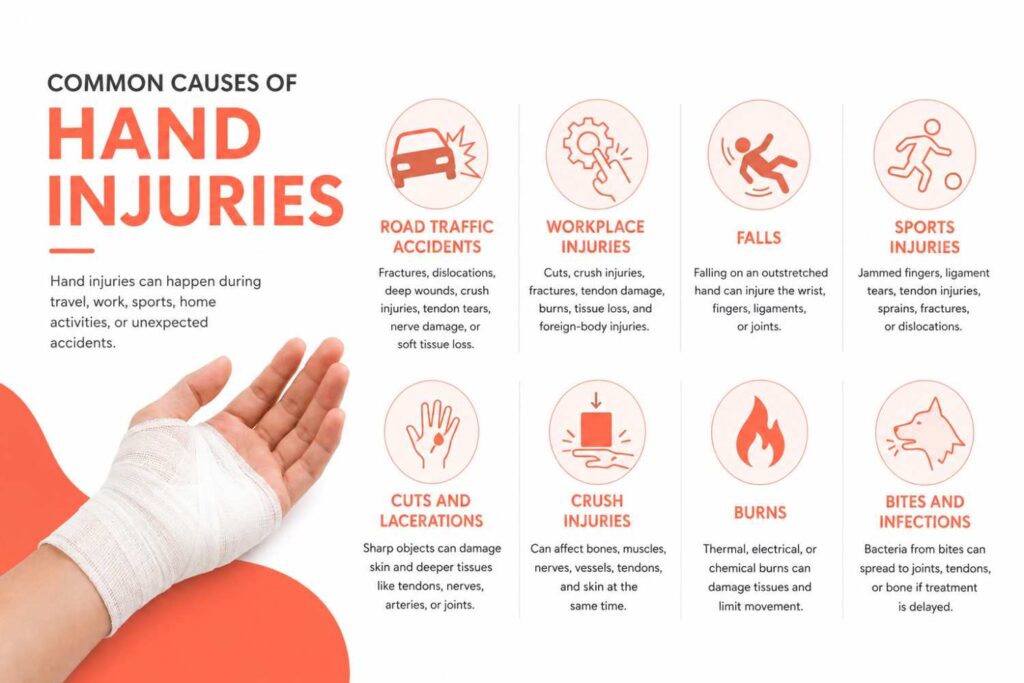
Hand injuries can happen during travel, work, sports, home activities, or unexpected accidents.
- Road Traffic Accidents
Road accidents may cause fractures, dislocations, deep wounds, crush injuries, tendon tears, nerve damage, or loss of soft tissue.
Motorcycle riders may injure the hand while falling, gripping the handlebar, or trying to protect themselves during impact.
- Workplace Injuries
People working with machines, tools, sharp objects, construction materials, or heavy equipment may experience:
- Deep cuts
- Crush injuries
- Finger fractures
- Tendon damage
- Burns
- Partial tissue loss
- Foreign-body injuries
Following workplace safety procedures can reduce risk, but immediate medical assessment is necessary when movement, sensation, or circulation is affected.
- Falls
Falling onto an outstretched hand can injure the wrist, fingers, ligaments, or joints. Fractures and dislocations are common after falls.
- Sports Injuries
Cricket, football, volleyball, basketball, badminton, martial arts, and weight training may cause jammed fingers, ligament tears, tendon injuries, wrist sprains, fractures, or dislocations.
- Cuts and Lacerations
Glass, knives, metal sheets, machinery, and other sharp objects can damage the skin and deeper tissues. A deep cut may injure a tendon, nerve, artery, or joint.
- Crush Injuries
Crush injuries may occur when the hand is trapped in a door, machine, vehicle, or beneath a heavy object. These injuries can affect bones, muscles, nerves, vessels, tendons, and skin at the same time.
- Burns
Thermal, electrical, or chemical burns can damage the skin and deeper tissues. Healing scars may later limit finger or wrist movement.
- Bites and Infections
Animal and human bites can introduce bacteria into the tissues. Infection may spread into joints, tendon coverings, or bone if treatment is delayed.
Types of Hand Injuries
Understanding the injury type is an important part of planning hand injury treatment in Thrissur.
- Hand and Finger Fractures
A fracture is a break in one or more bones. It may be:
- Stable
- Displaced
- Rotated
- Open
- Comminuted
- Joint-involving
Stable fractures may heal with splinting or casting. Unstable fractures may require fixation.
- Dislocations
A dislocation occurs when bones move out of their normal joint position. The joint may appear deformed and movement may become painful or impossible.
- Tendon Injuries
Tendons connect muscles to bones and allow fingers to bend or straighten. Tendons can be cut, stretched, ruptured, or pulled away from the bone.
- Nerve Injuries
Nerve injuries can cause:
- Numbness
- Tingling
- Burning sensations
- Weakness
- Loss of coordination
- Reduced protective sensation
Some nerve injuries recover with observation, while others may require surgical repair.
- Ligament Injuries
Ligaments connect bones and stabilise joints. Severe ligament damage may result in joint instability, weakness, pain, and reduced movement.
- Fingertip Injuries
Fingertip injuries can affect the nail, skin, bone, sensation, or soft-tissue padding. Treatment depends on the amount of tissue loss and whether bone is exposed.
- Open Wounds
Open wounds may contain dirt, glass, metal, or other foreign material. These injuries require careful cleaning and examination.
- Soft-Tissue Injuries
Soft-tissue injuries can involve the skin, muscles, fat, fascia, and connective tissues. Severe injuries may require reconstruction or wound coverage.
- Blood Vessel Injuries
Damage to an artery may reduce blood supply to a finger or part of the hand. Urgent treatment may be needed to preserve circulation.
Symptoms That Need Medical Attention
Seek medical evaluation after a hand injury when any of the following symptoms occur:
- Severe pain
- Increasing swelling
- Visible deformity
- Persistent bleeding
- Inability to move a finger
- Difficulty bending or straightening the hand
- Numbness or tingling
- Reduced grip strength
- A deep or dirty wound
- Exposed bone or tendon
- An unstable joint
- A pale, blue, or cold finger
- Pus or discharge
- Increasing redness
- Fever
- Pain that continues despite rest
- A wound caused by an animal or human bite
Loss of movement or sensation may indicate tendon or nerve damage even when pain is mild.
Non-Surgical Hand Injury Treatment
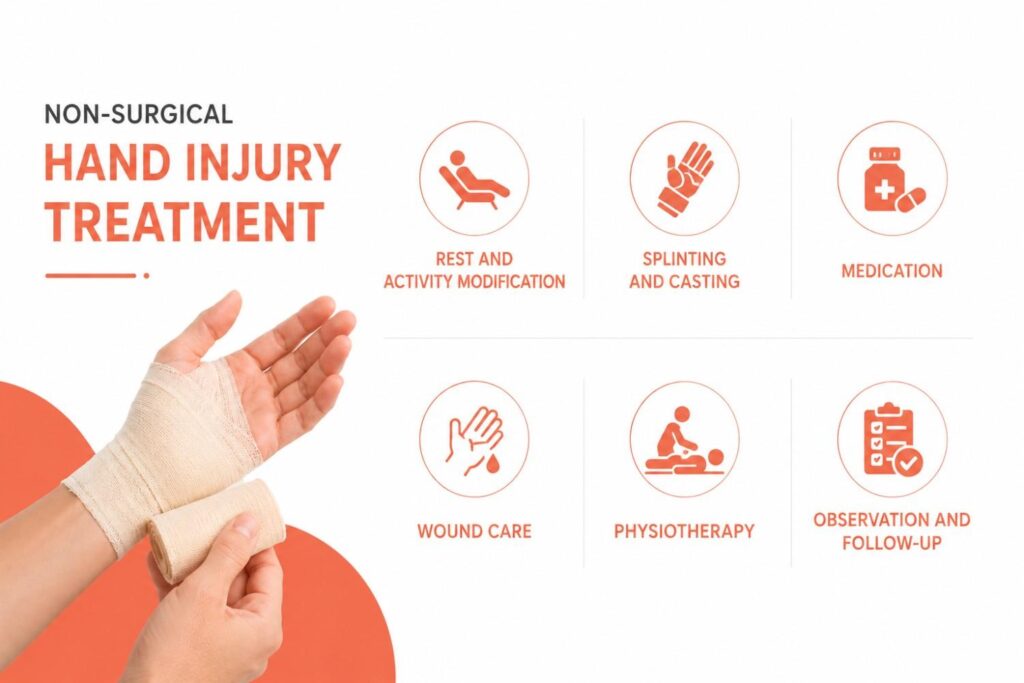
Not every hand injury needs surgery. Stable or less severe injuries may improve with conservative care.
- Rest and Activity Modification
Avoiding activities that worsen pain can protect healing tissues. However, unnecessary prolonged rest can contribute to stiffness.
- Splinting and Casting
A splint or cast can:
- Protect a fracture
- Support an injured tendon
- Stabilise a joint
- Reduce painful movement
- Maintain proper alignment
- Medication
Pain-relieving or anti-inflammatory medicines may be prescribed when appropriate. Antibiotics may be required for bites, contaminated wounds, or infection.
- Wound Care
Wound treatment may include:
- Cleaning
- Dressing
- Stitches
- Removal of foreign material
- Removal of damaged tissue
- Tetanus protection
- Infection monitoring
- Physiotherapy
Physiotherapy can improve joint movement, muscle strength, tendon glide, and coordination.
- Observation and Follow-Up
Regular review is important. A treatment plan may need to change if swelling, weakness, stiffness, pain, or instability continues.
Surgical Hand Injury Treatment in Thrissur
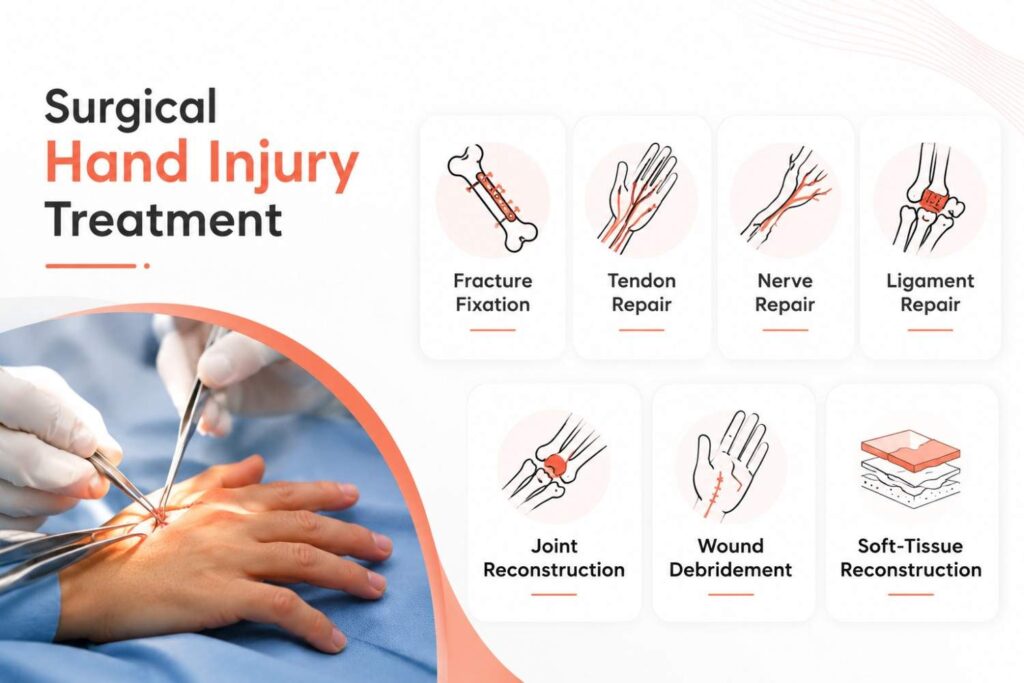
Surgery may be recommended when significant structures are damaged or when non-surgical care cannot restore stability and function.
- Fracture Fixation
Unstable fractures may be aligned and stabilised using:
- Pins
- Wires
- Screws
- Plates
- External fixation devices
The method depends on the fracture location, pattern, and stability.
- Tendon Repair
A cut or ruptured tendon may need repair to restore finger or wrist movement. The repaired tendon must be protected during early healing.
- Nerve Repair
Severed or severely damaged nerves may require:
- Direct repair
- Nerve grafting
- Nerve transfer
- Decompression
- Neurolysis
The selected procedure depends on the injury level, gap, and time since injury.
- Ligament Repair
A torn ligament may be repaired or reconstructed when joint instability affects movement and function.
- Joint Reconstruction
Severe joint injuries may require realignment, fixation, cartilage treatment, or reconstruction.
- Wound Debridement
Damaged or infected tissue may be removed to reduce infection risk and improve healing.
- Soft-Tissue Reconstruction
Skin grafts, local flaps, regional flaps, or free-tissue transfer may be used to cover exposed bone, tendon, nerve, or joint surfaces.
Microsurgery for Complex Hand Injuries
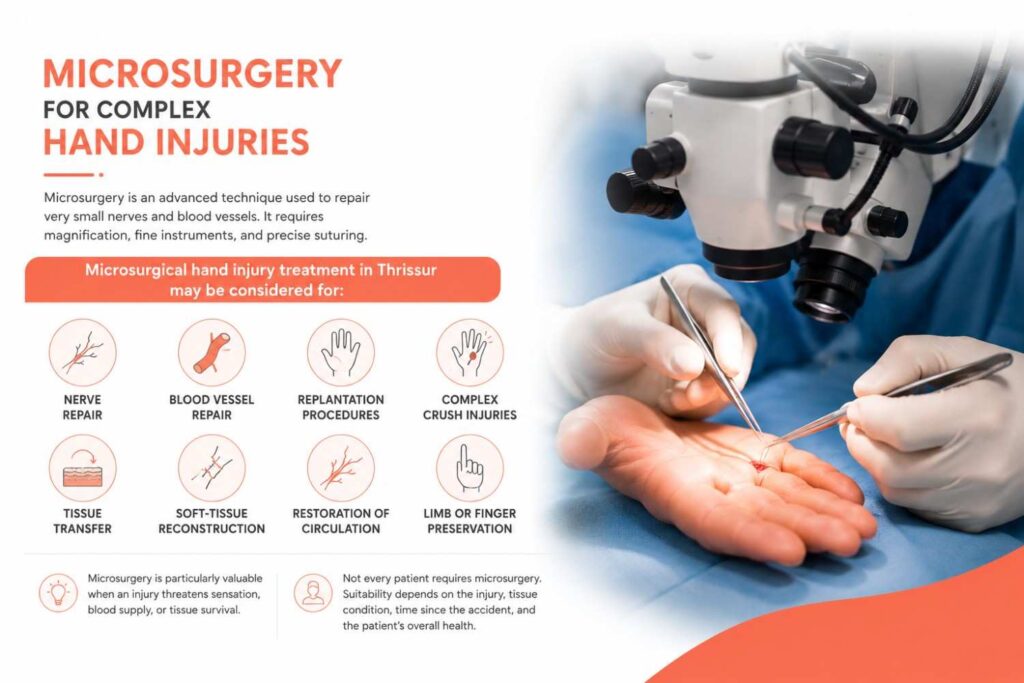
Microsurgery is an advanced technique used to repair very small nerves and blood vessels. It requires magnification, fine instruments, and precise suturing.
Microsurgical hand injury treatment in Thrissur may be considered for:
- Nerve repair
- Blood vessel repair
- Replantation procedures
- Complex crush injuries
- Tissue transfer
- Soft-tissue reconstruction
- Restoration of circulation
- Limb or finger preservation
Microsurgery is particularly valuable when an injury threatens sensation, blood supply, or tissue survival.
Not every patient requires microsurgery. Suitability depends on the injury, tissue condition, time since the accident, and the patient’s overall health.
Benefits of Timely Treatment
Early and appropriate hand injury treatment in Thrissur may provide several benefits.
- Better Movement
- Improved Grip Strength
- Protection of Sensation
- Reduced Pain
- Prevention of Deformity
- Lower Infection Risk
- Better Independence
Recovery After Hand Injury Treatment
Recovery time varies depending on the injury.
A minor injury may improve within a few weeks, while a complex nerve, tendon, bone, or soft-tissue injury may require several months of healing and rehabilitation.
The recovery plan may include:
- Dressing care
- Elevation
- Splinting
- Medication
- Wound monitoring
- Movement exercises
- Scar care
- Strengthening
- Sensory retraining
- Return-to-work planning
- Follow-up imaging
Patients should avoid heavy lifting until the treating specialist confirms that the tissues are ready.
Choosing a Hand Injury Specialist
Complex hand injuries may involve bones, tendons, nerves, joints, blood vessels, and skin. A specialist experienced in reconstructive surgery and microsurgery can assess these structures together.
When choosing a specialist, consider:
- Relevant medical qualifications
- Experience with hand trauma
- Experience in tendon and nerve repair
- Availability of microsurgical treatment
- Approach to rehabilitation
- Clear explanation of treatment options
- Follow-up support
- Coordination with physiotherapists
- Hospital facilities
- Emergency-care availability
Patients should feel comfortable asking about the diagnosis, treatment alternatives, expected recovery, possible risks, and rehabilitation plan.
Conclusion
Hand injuries can affect bones, tendons, nerves, joints, blood vessels, muscles, and skin. Proper treatment begins with identifying every damaged structure and understanding how the injury affects movement, sensation, circulation, and daily function.
Comprehensive hand injury treatment in Thrissur may include splinting, fracture care, wound management, tendon repair, nerve reconstruction, microsurgery, soft-tissue coverage, and structured rehabilitation. The treatment plan should be based on the type and severity of the injury rather than symptoms alone.
Patients from Thrissur and other parts of Kerala should seek early evaluation when an injury causes numbness, weakness, deformity, severe swelling, loss of movement, deep wounds, or circulation changes. Timely hand injury treatment in Thrissur, regular follow-up, and carefully guided rehabilitation can support better movement, strength, sensation, and long-term hand function. For additional information about breast augmentation procedures and implant safety, visit the American Society of Plastic Surgeons Breast Augmentation Resources.
Table Of Contents
WHO NEEDS HAND INJURY TREATMENT?
Lorem ipsum dolor sit amet, consectetur adipiscing elit. Ut elit tellus, luctus nec ullamcorper mattis, pulvinar dapibus leo.
WHICH HAND INJURIES NEED SURGERY
Lorem ipsum dolor sit amet, consectetur adipiscing elit. Ut elit tellus, luctus nec ullamcorper mattis, pulvinar dapibus leo.
WHY IS EARLY TREATMENT IMPORTANT?
Lorem ipsum dolor sit amet, consectetur adipiscing elit. Ut elit tellus, luctus nec ullamcorper mattis, pulvinar dapibus leo.
FREQUENTLY ASKED QUESTIONS

Dr Vinu Roy
Plastic and Cosmetic SurgeonDr Vinu Roy is a plastic and cosmetic surgeon with expertise in cosmetic surgery, reconstructive surgery, microvascular surgery, hand surgery, trauma reconstruction, and brachial plexus procedures.
He focuses on enhancing both form and function with personalized surgical care, helping patients achieve their aesthetic and reconstructive goals with confidence.
Sushrutha Institute of Plastic, Reconstructive, and Aesthetic Surgery, Elite Mission Hospital, Koorkenchery, Thrissur

