
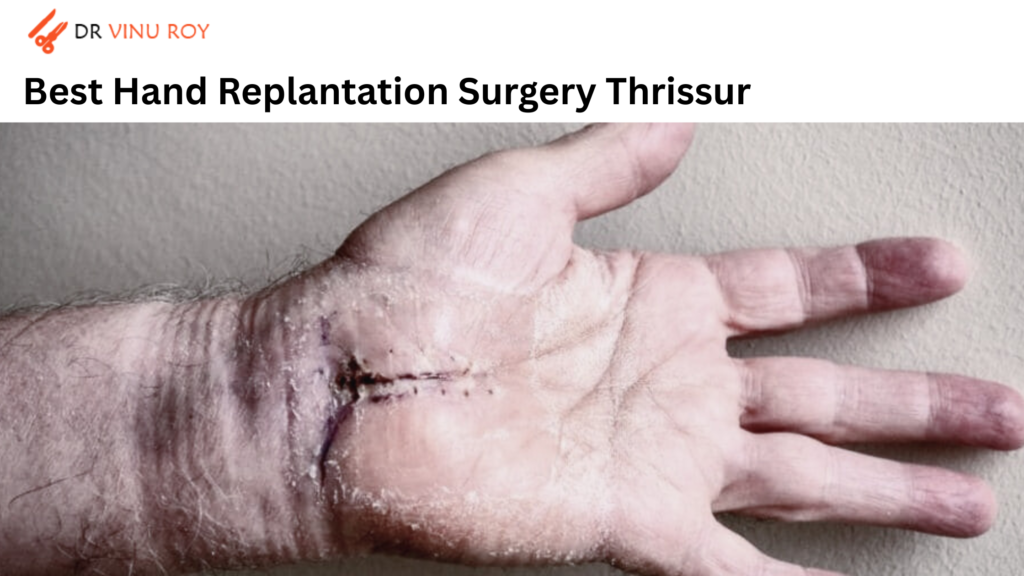
Waking up to the terrifying reality of a traumatic hand injury or amputation is life-altering. The function, feel, and form of a hand cannot be replaced easily. In such critical moments, timely and expert intervention becomes the difference between lifelong disability and full recovery. For patients seeking the Best Hand Replantation Surgery Thrissur, Dr. Vinu Roy and his expert team at the Sushrutha Institute of Plastic, Reconstructive, and Aesthetic Surgery, Elite Mission Hospital, Koorkenchery, Thrissur, offer internationally recognized microsurgical care.
What Is Hand Replantation Surgery?
Hand replantation is a complex surgical procedure aimed at reattaching a completely severed hand, finger, or limb back to the body. The primary goal is to restore both form and function, allowing the patient to regain as much use of the hand as possible.
Performed under a high-powered operating microscope, this intricate surgery involves the careful reconnection of multiple anatomical structures, including:
Bones – stabilized using metal plates, screws, or K-wires to restore the skeletal framework.
Tendons and Muscles – reattached to allow flexion, extension, and coordinated hand movement.
Arteries and Veins – meticulously sutured to restore blood flow, a crucial step for tissue survival.
Nerves – aligned and joined to enable the gradual return of sensation and motor control.
A Time-Sensitive Procedure
Time is of the essence. Replantation must be attempted within a narrow window (ideally within 6–12 hours for warm ischemia or up to 24 hours if the part is properly cooled). Success is highly dependent on how the amputated part is preserved and how quickly the patient receives care.
Expertise Required
This is not a routine procedure. Hand replantation demands specialized microsurgical skills, advanced infrastructure, and a multidisciplinary support team. That’s why only high-volume centers with experienced surgeons—like Dr. Vinu Roy at Sushrutha Institute of Plastic, Reconstructive, and Aesthetic Surgery, Elite Mission Hospital, Thrissur—can deliver consistently excellent outcomes.
When Is Replantation Recommended?
Hand replantation is a life-changing procedure, but it’s not suitable for every case. It is typically considered only in specific types of traumatic amputations, where there is a real potential to restore meaningful function.
Common Causes Where Replantation May Be Considered
Replantation is most often recommended in situations involving:
Industrial or Workplace Accidents
High-speed machinery such as cutting blades, conveyor belts, or press machines can cause clean amputations—making them ideal for replantation.Agricultural Equipment Injuries
Tractors, threshers, or sugarcane machines often cause severe limb trauma. While not all are clean amputations, select cases are still considered for replantation if quickly addressed.Road Traffic Accidents (RTAs)
Motorcycle handlebar injuries or car door crushes can lead to partial or complete amputation. Timely surgical attention increases the chances of saving the limb.Sharp Object Trauma
Injuries involving knives, glass, or saws often create clean-cut amputations, which are the most suitable for hand replantation surgery.
Key Factors That Determine Suitability
Whether or not a patient is eligible for the Best Hand Replantation Surgery Thrissur depends on several clinical and logistical factors:
Type of Injury
Clean-cut amputations (e.g., sharp blade injuries) have the highest success rate.
Crushed, avulsed, or mangled parts are more challenging and may not be ideal candidates.
Time Since Amputation
The golden window for replantation is ideally within 6 hours for warm parts, and up to 12–24 hours for parts kept cold (wrapped in saline gauze and kept on ice, not directly in ice).Condition of the Amputated Part
The way the severed hand or finger is preserved greatly affects success. Clean, intact, and well-cooled parts are most viable.Patient’s General Health
Individuals with uncontrolled diabetes, vascular disease, or major trauma may not tolerate prolonged surgery and recovery.
Time = Tissue
We urge the public to act swiftly during such emergencies. Immediate steps you can take before reaching the hospital include:
Gently wrap the amputated part in sterile gauze soaked in clean saline.
Place it in a sealed plastic bag.
Keep the bag over ice—do not place the part directly on ice or water.
Bring the patient and the part to a hospital with microsurgical expertise—such as the Sushrutha Institute of Plastic, Reconstructive, and Aesthetic Surgery, Elite Mission Hospital, Thrissur.
How Replantation Is Performed ?
At the Sushrutha Institute of Plastic, Reconstructive, and Aesthetic Surgery, housed within Elite Mission Hospital, Koorkenchery, Thrissur, hand replantation is more than just a surgical procedure—it is a race against time and a marvel of modern microsurgery.
Led by Dr. Vinu Roy, a pioneer in reconstructive and hand microsurgery, each case is approached with clinical precision and care. To deliver the Best Hand Replantation Surgery Thrissur, our team uses advanced tools such as:
High-Powered Operating Microscopes – For magnifying tiny blood vessels and nerves up to 40x, allowing exact repairs.
Micro-Instruments and Micro-Sutures – Designed for delicate handling of arteries as thin as a strand of hair.
Fluorescent Imaging and Doppler Monitoring – To ensure real-time blood flow during and after the procedure.
Step-by-Step: What Happens During Hand Replantation
This highly structured and delicate operation is carried out in carefully sequenced steps. Here’s what happens inside the operating room during the Best Hand Replantation Surgery Thrissur:
1. Debridement
The first step is to thoroughly clean both the amputated part and the remaining stump. Damaged or contaminated tissue is removed to reduce infection risk. This step is critical to setting up a clean foundation for the repair.
2. Bone Fixation
Using K-wires or mini-plates, the surgeon aligns and stabilizes the bone ends. Proper skeletal alignment is crucial for later tendon function and hand strength. This skeletal “scaffolding” provides the structure for the rest of the surgery.
3. Vascular Repair (Arteries and Veins)
Under the microscope, arteries and veins are identified, trimmed, and reconnected using ultra-fine sutures—some thinner than human hair. Blood flow is restored first to prevent tissue death, and the part is monitored for signs of successful circulation. This is often the most time-critical and technically demanding step in the entire process.
4. Tendon and Nerve Repair
Tendons are then carefully reattached to allow movement of the fingers and wrist. Flexor and extensor tendons are repaired to restore grasp and release functions.
Next, the sensory and motor nerves are microscopically aligned. Though nerve recovery takes time, this step is vital for returning feeling and coordinated movement.
5. Skin Closure
Once all deep structures are repaired, the skin is closed. In some cases, skin grafts or local flaps may be used if there’s loss of soft tissue. The closure must be tension-free and clean to promote optimal healing.
Why Dr. Vinu Roy
With over two decades of dedicated experience in advanced microsurgical procedures, Dr. Vinu Roy has emerged as one of the most respected and trusted names in Kerala for complex hand trauma and replantation surgeries. His unwavering commitment to excellence and innovation in microsurgery has positioned him as a leading authority in the field.
At the Sushrutha Institute of Plastic, Reconstructive, and Aesthetic Surgery, located at Elite Mission Hospital, Koorkenchery, Thrissur, Dr. Vinu Roy leads a highly specialized team that routinely handles some of the most challenging and delicate hand trauma cases in the region. From partial amputations to complete hand and finger reattachments, his unit is equipped with state-of-the-art technology and an evidence-based approach that ensures optimal outcomes.
Patients from across Kerala and neighboring states seek his care not only because of his technical mastery but also due to the compassionate, patient-centered treatment philosophy that guides every case. The unit’s consistently high success rates and commitment to restoring function, sensation, and quality of life make it the go-to destination for the Best Hand Replantation Surgery Thrissur offers.
Choosing the right surgeon is critical when it comes to limb salvage and functional restoration. With Dr. Vinu Roy, patients receive world-class surgical expertise, meticulous post-operative care, and personalized rehabilitation plans—ensuring that every individual has the best possible chance at a full and meaningful recovery.
Hand replantation is a complex microsurgical procedure that involves reattaching a severed hand, finger, or limb to restore form and function. Under the leadership of Dr. Vinu Roy, this intricate surgery is performed at the Sushrutha Institute of Plastic, Reconstructive, and Aesthetic Surgery, Elite Mission Hospital, Koorkenchery, Thrissur—recognized for offering the Best Hand Replantation Surgery Thrissur.
Time is critical. Ideally, patients should reach a qualified surgical center within 6 hours of injury. However, if the amputated part is properly preserved in a cold, sterile environment, successful replantation may be possible even up to 12–24 hours later. Dr. Vinu Roy’s team is available 24/7 to assess and act swiftly.
Gently rinse the amputated part with clean saline or water (if dirty).
Wrap it in saline-soaked sterile gauze.
Place it inside a clean plastic bag, sealed tightly.
Place the bag over ice packs (not directly on ice or in water).
This greatly increases the chances of a successful replantation by Dr. Vinu Roy and his microsurgical team.
Dr. Vinu Roy: Often, yes. Additional procedures like skin grafting, tendon release, or nerve repair may be needed in the months following. These are part of the planned recovery pathway to optimize hand function.
Dr. Vinu Roy: Intensive physiotherapy and occupational therapy are crucial. Therapy typically begins within a few days after surgery and may continue for 6–12 months. This includes exercises for mobility, strength, and coordination.

